
Leadership in Uncertainty: How Proactive Experimentation Built a Lockdown-Ready Team

📑 Table of Contents
- 1. Executive Summary
- 2. Introduction & Background
- 3. The Operational Challenge
- 4. The Pre-Crisis Conundrum: A Case Study in Leadership Foresight
- 5. The Three-Pillar Framework for Proactive Transformation
- 6. The Payoff: Results and Tangible Business Impact
- 7. The Leadership Playbook: Principles for Navigating Uncertainty
- 8. Conclusion: Building Bridges Before the Flood
- 9. Appendix: Tools and Frameworks for Replication
1. Executive Summary
The 2020 global pandemic was the ultimate stress test for organizational resilience, triggering a frantic shift to remote work. While many companies faltered, a select few not only survived but thrived.
This white paper analyzes one such success story: a 200+ member advertising team that had already built a lockdown-ready operation before the first case of COVID-19 was announced. Their secret? Proactive leadership and deliberate experimentation in 2019.
We detail a replicable framework for building a future-ready organization, documented through the real-world transformation of this team. Faced with predictable seasonal staffing shortages, leadership adopted a radical "what-if" mindset. They launched a series of deliberate experiments—including minute-by-minute transparency and a mandatory Work-From-Home (WFH) dry run—that forged a culture of agility and trust before the global crisis hit.
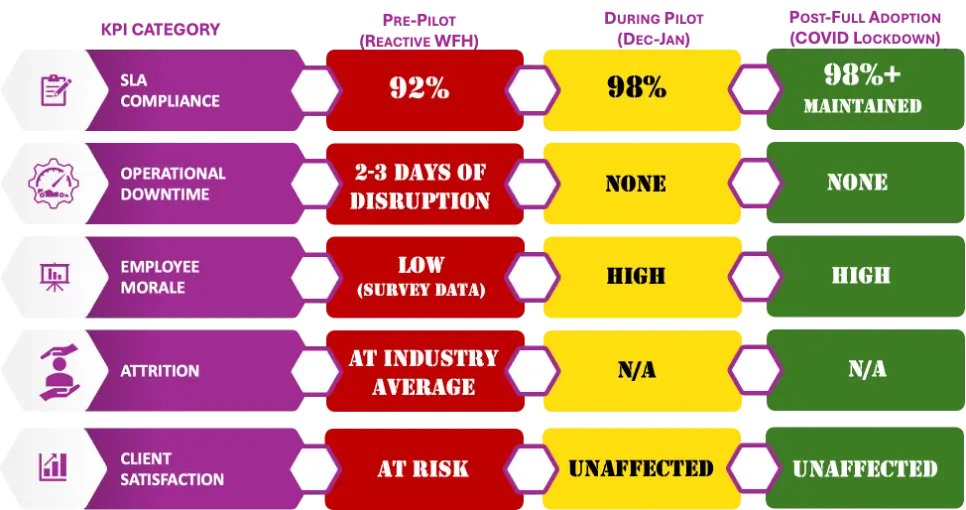
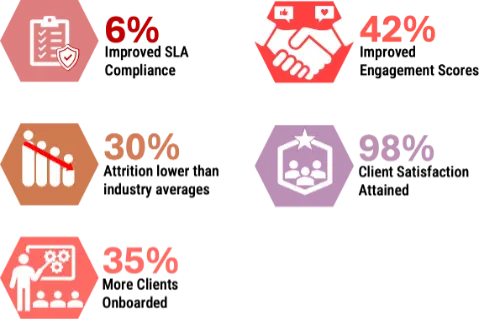
The results demonstrate that resilience is not born from crisis response, but is built proactively through a leadership philosophy that values data over dogma, experimentation over inertia, and trust over control. The outcome was continuous operations with zero downtime, 98% SLA compliance, and employee attrition 30% lower than industry averages.
This paper provides a blueprint for leaders seeking to build organizations that can not only withstand disruption but emerge from it stronger.
2. Introduction & Background
The 21st-century business landscape is defined by volatility, uncertainty, complexity, and ambiguity (VUCA). Traditional models of work, built on assumptions of colocation and presenteeism, are increasingly fragile. The COVID-19 pandemic was not an anomaly but a catalyst, accelerating a shift towards remote and hybrid work that was already underway.
However, the suddenness of this shift exposed a critical gap: most organizations were reactive, not proactive. They lacked the systems, culture, and leadership frameworks to adapt seamlessly. This white paper presents a counter-narrative. It explores how one organization's leadership team, by embracing a forward-looking and experimental approach, turned potential vulnerability into a formidable competitive advantage. Their journey offers critical lessons for any leader aiming to future-proof their operations.
Key facts from the case study:
- Team size: 200+ advertising operations members.
- Core time window of concern: Q3 (Oct–Dec) due to festival leaves and client peak demand.
- The pilot program included a forced WFH dry run (Dec 23 – Jan 6) and full adoption in Feb 2020 prior to the March lockdown.
3. The Operational Challenge
The organization faced three interlinked problems:
- Predictable capacity shortages during a peak business window.
- Low visibility into work distribution and true bottlenecks.
- Cultural norms of presenteeism that masked inefficiencies.
These problems caused SLA violations, reduced morale, and inability to scale quickly when new work arrived. Leadership recognized that a system-level redesign — not a people-level 'fix' — was necessary.
4. The Pre-Crisis Conundrum: A Case Study in Leadership Foresight
4.1 The Presenting Problem: Seasonal Staffing Shortages
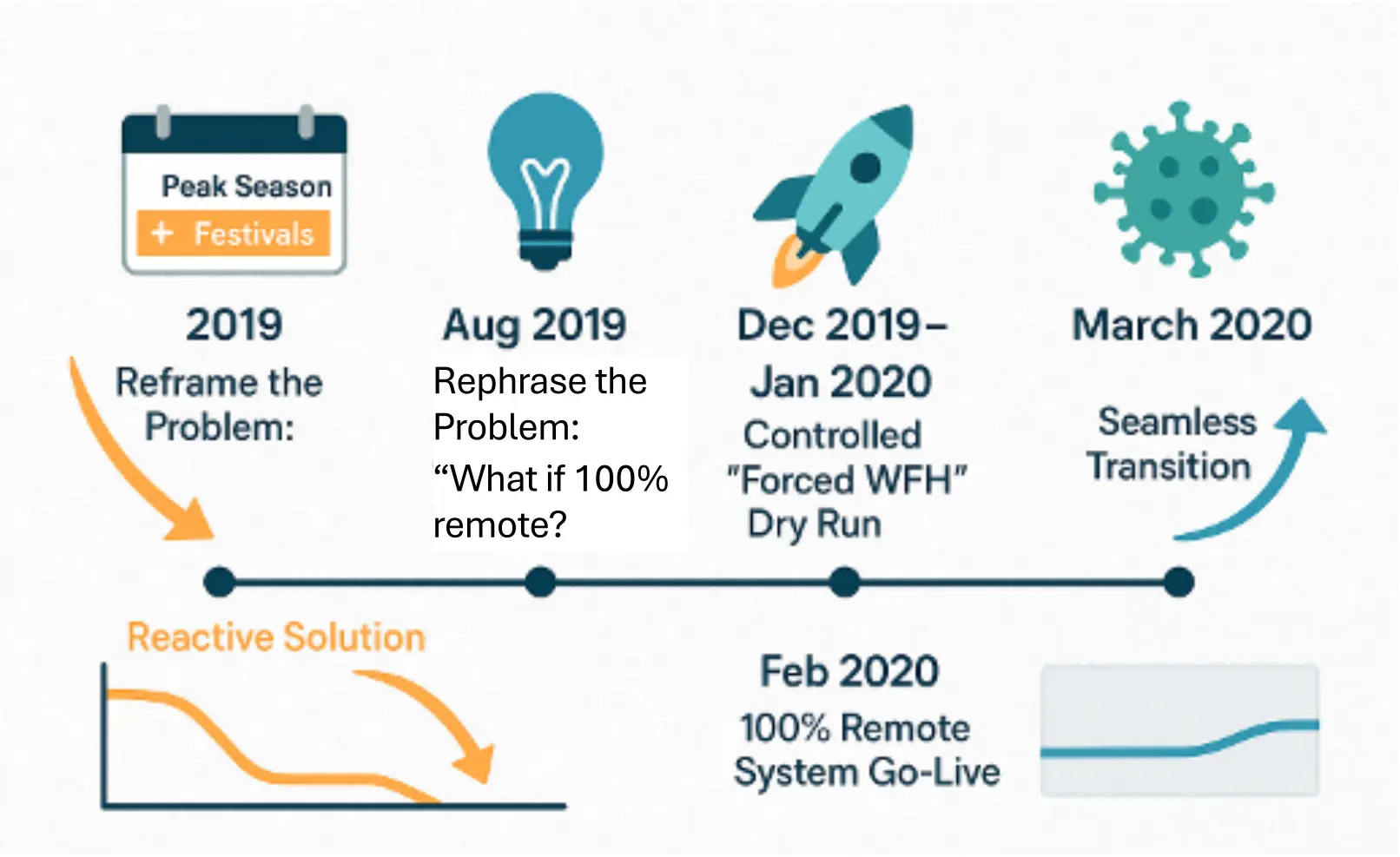
In Q3 2019, the leadership team faced a familiar operational challenge. Annual peak demand from US/UK markets coincided with extended festival leaves in India, creating a predictable staffing shortage. Historical reactive solutions—mandatory work-from-home (WFH) days and shifted schedules—consistently failed, leading to plummeting productivity, missed service-level agreements (SLAs), and sinking team morale.
4.2 The Leadership Insight: Stress-Testing for the Unknown
Instead of applying another temporary fix, leadership reframed the problem. They asked a transformative question: "How do we build a system that works even if 100% of the team is remote—indefinitely?" This was not about predicting a pandemic; it was about building antifragility. The goal was to:
- Stress-test operations for worst-case scenarios.
- Experiment early to avoid panic-driven decisions later.
- Leverage data to replace assumptions about productivity and trust.
5. The Three-Pillar Framework for Proactive Transformation
The initiative's success was grounded in a strategic framework built on three interconnected pillars.
5.1 Pillar 1: Radical Transparency & Data-Driven Decision Making
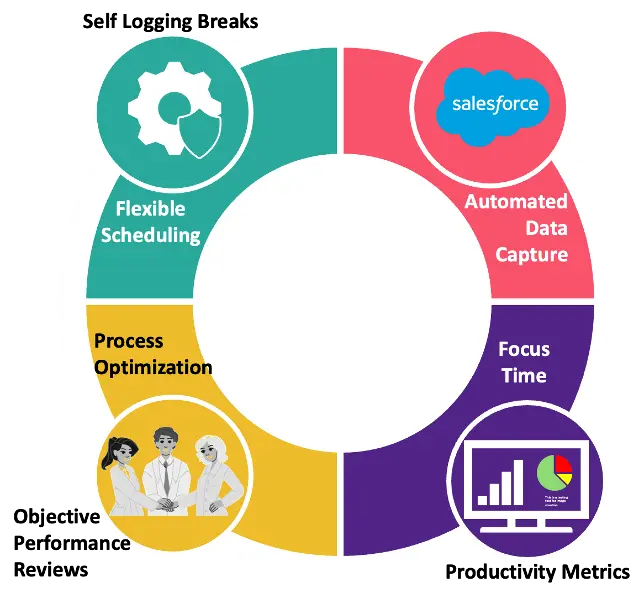
The controversial decision to implement minute-by-minute tracking was framed not as surveillance but as a quest for objective insight.
- Methodology: Leveraged existing Salesforce ticketing logs to auto-capture task time, eliminating manual, error-prone timesheets.
- Building Trust: Crucially, the system allowed for self-logged breaks (e.g., for YouTube, sports), acknowledging that focus is not infinite and empowering employees to manage their time authentically.
- Outcome: The data proved that productivity did not drop; it became more visible. This dismantled the dogma that "WFH is less productive" and replaced it with evidence.
5.2 Pillar 2: Deliberate Experimentation & Controlled Stress-Testing
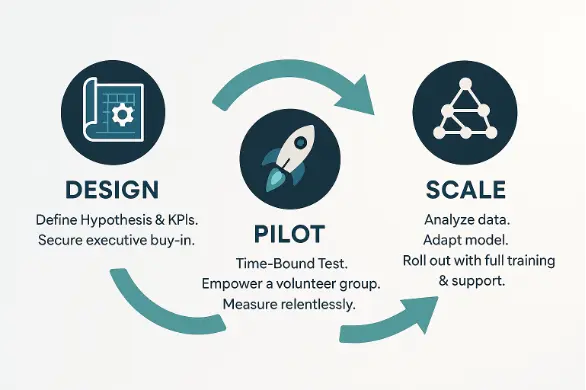
Leadership did not mandate a permanent change. They launched a time-bound, controlled experiment.
- The Dry Run: A two-week "forced WFH" pilot was executed during Dec 23 – Jan 6, a period of lower live client demand but similar operational requirements.
- Measuring Success: KPIs were strictly monitored: SLA compliance stayed at 98% (vs. 92% in-office during peak season), and employee feedback highlighted improved focus.
- The Decisive Move: Based on pilot data, leadership mandated full adoption of the remote-ready system in February 2020, a month before global lockdowns. This meant the transition was a mere optimization, not a chaotic scramble.
5.3 Pillar 3: Cultural & Psychological Safety Infrastructure
Technology and process are useless without cultural buy-in. Leadership invested deeply in creating a safe environment for change.
- Co-Creation: Employees were engaged as partners through "Future of Work" task forces and transparent feedback loops.
- Psychological Safety: A "no penalty" policy for pilot participants and anonymous feedback channels ensured honest input.
- Leadership Vulnerability: Leaders shared their own adaptation challenges, normalizing the learning curve and building solidarity.
6. The Payoff: Results and Tangible Business Impact
The quantitative and qualitative results validated the proactive approach, especially when the crisis hit.
6.1 Key Performance Indicators — Pre, During, and Post-Pilot
6.2 The Ripple Effect of Proactive Leadership
7. The Leadership Playbook: Principles for Navigating Uncertainty
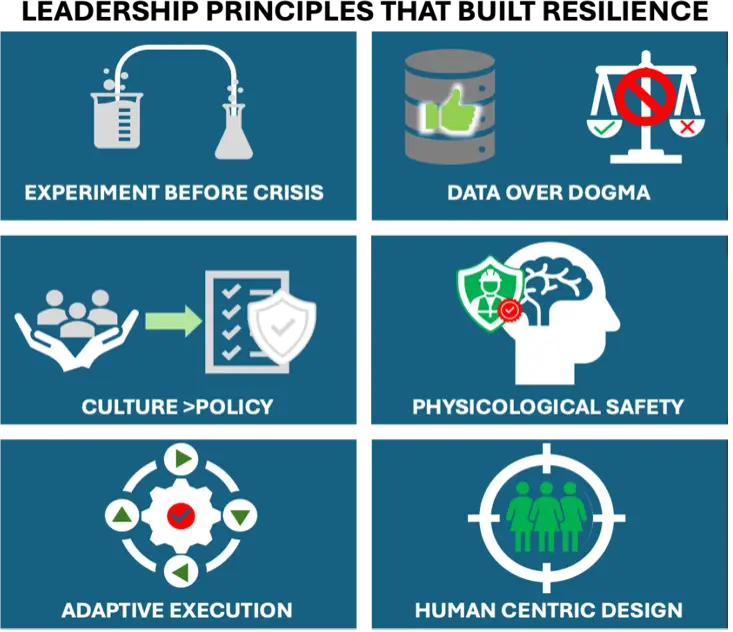
This case study distils into a core set of actionable leadership principles:
- Embrace Anticipatory Thinking: Regularly ask "What if?" and run pre-mortems on critical operations. Allocate a budget for future-proofing experiments.
- Prioritize Data Over Dogma: Challenge long-held assumptions with controlled experiments. Let empirical evidence, not tradition, guide policy.
- Invest in Trust, Not Control: Build systems based on transparency and adult-to-adult relationships. Empower employees with autonomy and they will reciprocate with accountability.
- Communicate the "Why" Relentlessly: Frame change not as a fix for a problem, but as an investment in a more resilient, competitive future.
- Build Modularly: Create policies and systems that are adaptable. What works today may not work tomorrow, design for change.
7.1 Implementation Roadmap
A practical, phased roadmap for organizations seeking to replicate the model:
- Phase 0 — Diagnostic (2–4 weeks): baseline SLA, workflow mapping, identify tasks requiring physical presence (case study found ~17%).
- Phase 1 — Pilot (4–8 weeks): choose 1–2 teams, enable auto-capture task logs, run a forced WFH dry run, collect pulse feedback.
- Phase 2 — Scale (2–3 months): expand to business-critical teams, standardize dashboards and SOPs, train transition coaches.
- Phase 3 — Continuous Optimization (Ongoing): 48-hour test cycles, monthly review gates, learning logs and pre-mortems.
Checklist for leaders (operational and cultural):
✓ Map workflows and identify critical on-site tasks
✓ Integrate ticketing/time-capture with minimal manual effort
✓ Design 'no-penalty' pilot policies and anonymous feedback
✓ Run a forced WFH dry run to test full remote operation
✓ Publicly recognize change champions and early adopters
✓ Measure SLAs, engagement, attrition and client satisfaction continuously
7.2 Risks & Mitigations
- Perception of surveillance/micromanagement → Mitigation: Use auto-capture from ticketing logs, allow self-logged breaks, communicate outcome focus.
- Tool overload and admin friction → Mitigation: Minimize manual entry, choose integrations that reduce duplication.
- Equity concerns across roles → Mitigation: Map which activities truly require physical presence and provide hybrid options.
- Data privacy and security → Mitigation: Adhere to least-privilege access controls and anonymize pulse feedback.
7.3 Templates & Tools
A. Pulse survey sample (weekly):
1. I have the tools to do my job remotely. (1–5)
2. My manager provides clear priorities. (1–5)
3. I can take breaks without penalty. (Yes/No)
4. What's one improvement we'd like to test next week? (free text)
B. Pre-mortem checklist (top categories): People, Tools, Communications, Legal/Compliance, Client Handoffs.
C. Sample SLA formula (simplified): SLA% = (Number of tickets resolved within SLA / Total tickets) * 100
8. Conclusion: Building Bridges Before the Flood
This case demonstrates that anticipatory leadership, disciplined experiments, and data-driven decisions can transform a recurring operational problem into a long-term competitive advantage. Key recommendations for leaders:
- Start small but be bold — run a forced WFH dry run to surface operational gaps.
- Measure outcomes not hours — auto-capture where possible and make dashboards visible.
- Preserve human dignity — embed psychological safety and allow autonomy.
- Treat 'future-readiness' as continuous work, not a one-time project.
The story of this advertising team is a powerful testament to the value of proactive leadership. The organization in this case did not merely survive a global crisis — it thrived because leadership saw an opportunity to build a bridge to a future no one could yet see. When the flood came, they didn't need to build; they simply crossed.
The ultimate lesson is that resilience is a choice made in calm weather. It is the product of curiosity, courage, and a commitment to building organizations that are not only efficient but also adaptive, trusting, and inherently human-centric. The next disruption is inevitable. The question is: will you be forced to react, or will you have already prepared?
9. Appendix: Tools and Frameworks for Replication
- Hypothesis Testing Template: For designing pilots.
- Pre-Mortem Exercise Guide: To identify potential failure points.
- KPI Dashboard Example: Key metrics to track for remote work pilots.
- Change Management Checklist: For rolling out new ways of working.
- Stakeholder Communication Plan: To secure buy-in at all levels.
All insights derived from real-world case study (200+ member advertising team, 2019-2020).
DOWNLOAD PDF VERSION