
The Zero Surprise Delivery Framework

📑 Table of Contents
- 1. Executive Summary
- 2. Introduction: The High Cost of Operational Opacity
- 3. The Pre-Transformation State: A Culture of Reactive Firefighting
- 4. The Paradigm Shift: Introducing the Zero Surprise Delivery Framework
- 5. The Technology Enabler: The Role of the Shared Dashboard
- 6. Measuring Impact: Quantifying the Value of Trust
- 7. Analysis: Key Success Factors and Implementation Challenges
- 8. Conclusion: Reliability as the Ultimate Competitive Advantage
- 9. Appendix: Starter Kit for Implementing Zero Surprise Delivery
1. Executive Summary
In the high-stakes world of digital marketing operations, the greatest risk is not failure—it is the unexpected surprise. For a team executing complex, multi-channel campaigns, a culture of reactive firefighting and opaque processes led to missed deadlines, eroded client trust, and team burnout. This white paper details the design and implementation of the "Zero Surprise Delivery" framework, a holistic operational model that transformed performance and client relationships.
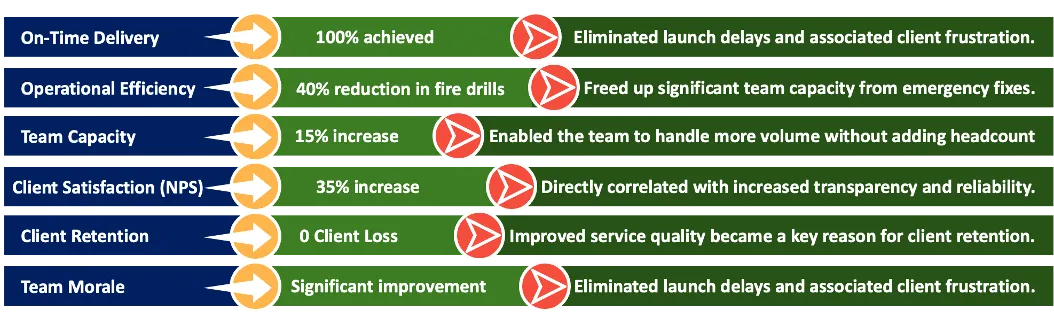
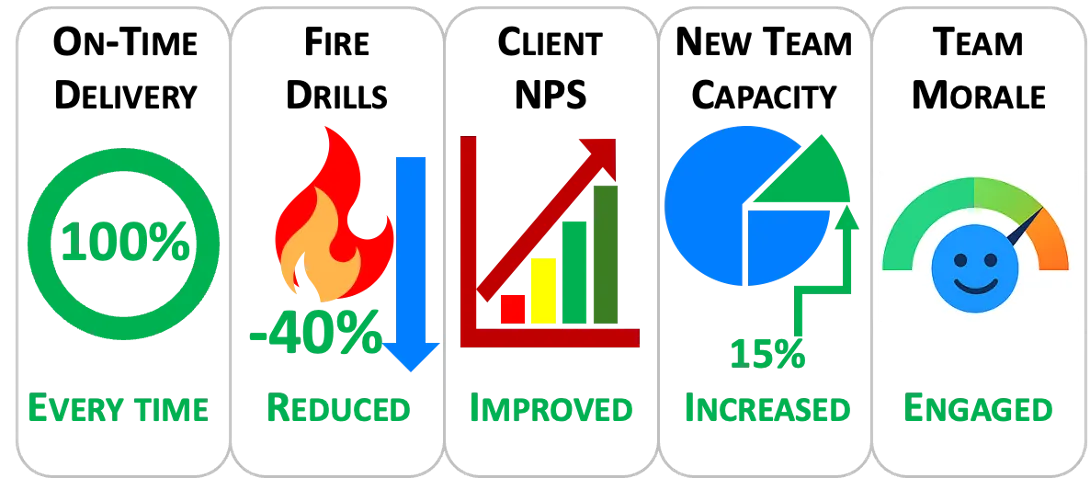
Built on three core pillars—(1) Pre-emptive Quality Control, (2) Structured Transparency, and (3) Collaborative Resolution—this framework systematically eliminates surprises by shifting issue identification to the very beginning of the workflow. The results were transformative: 100% on-time delivery, a 35% increase in Net Promoter Score (NPS), a 40% reduction in fire drills, and a 15% increase in team capacity.
This paper provides a proven blueprint for any service delivery organization seeking to transition from a reactive "order-taker" to a proactive, trusted partner, demonstrating that operational transparency is the most powerful currency for building long-term client trust and sustainable growth.
2. Introduction: The High Cost of Operational Opacity
Digital operations teams are the engine of modern marketing, responsible for flawlessly executing campaigns across email, SMS, push notifications, and more. However, many of these teams operate as "black boxes." Clients and account managers submit a request and then wait anxiously until the promised delivery time, hoping for the best but often experiencing the worst: last-minute delays, missing assets, and technical errors. This opacity creates a climate of anxiety, undermines trust, and forces teams into a reactive, firefighting mode that is unsustainable and costly. The "Zero Surprise Delivery" framework addresses this fundamental flaw by making transparency and proactive communication the core of the operational model.
3. The Pre-Transformation State: A Culture of Reactive Firefighting
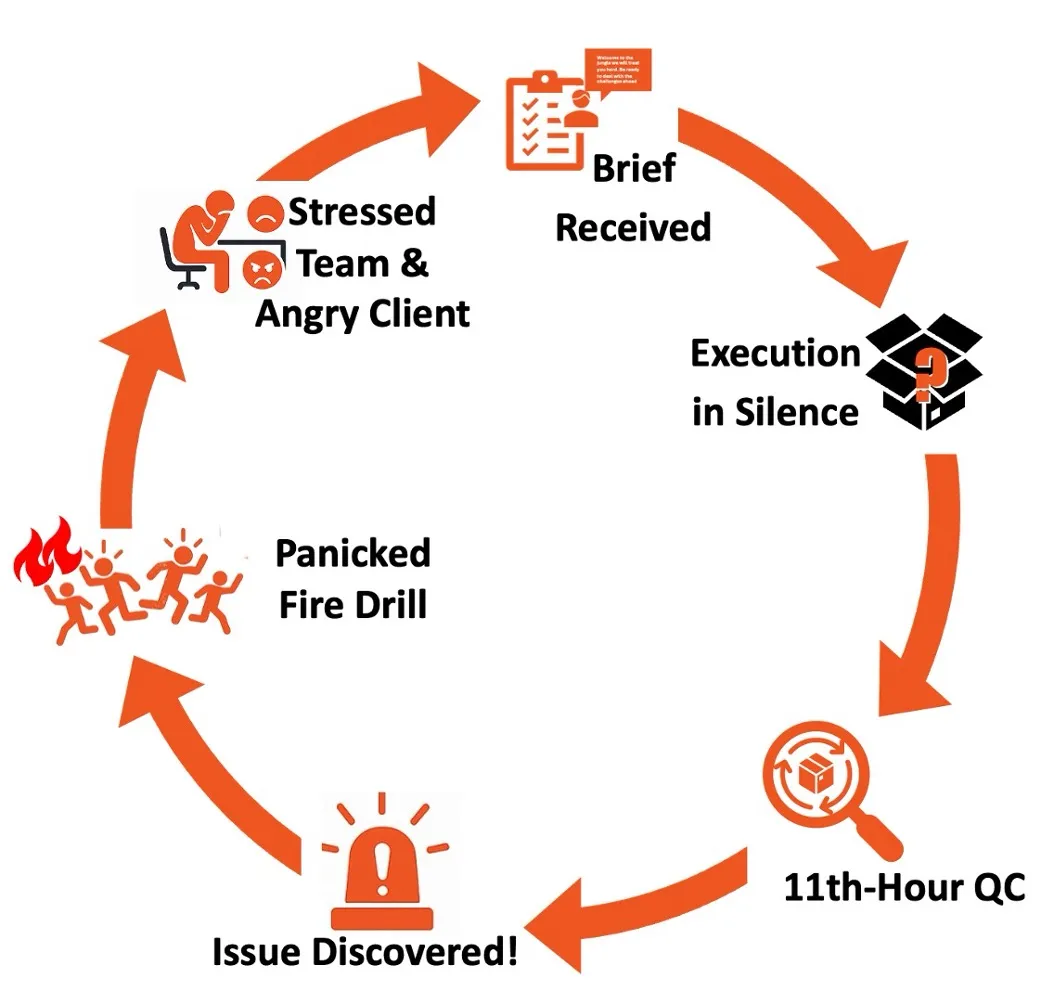
The client's operations team was trapped in a vicious cycle, characterized by two core dysfunctions.
3.1. The "Black Box" of Execution
The workflow was linear and siloed: Brief → Execution → Quality Check (QC) → Launch. The critical flaw was that the first quality check happened just hours before launch. Account Managers and clients had zero visibility into progress during the execution phase, existing in an information vacuum that was a primary source of anxiety.
3.2. The Domino Effect of Last-Minute Surprises
When a missing asset or a critical error was discovered at the final QC stage, it triggered a high-pressure emergency. This required pulling resources from other projects, demanding rushed work from clients, and often resulted in delayed launches that made the entire organization appear unprepared and unprofessional.
4. The Paradigm Shift: Introducing the Zero Surprise Delivery Framework
The solution was not a minor process tweak but a fundamental cultural and operational shift. The "Zero Surprise Delivery" framework is built on three interconnected pillars designed to create a system of proactive transparency.
- Pillar 1: Pre-emptive Quality Control (Pre-QC)
- Pillar 2: Structured & Transparent Communication
- Pillar 3: Collaborative, Parallelized Resolution
4.1 Pillar 1: Pre-Emptive Quality Control (Pre-QC) -- Shifting Left for Safety
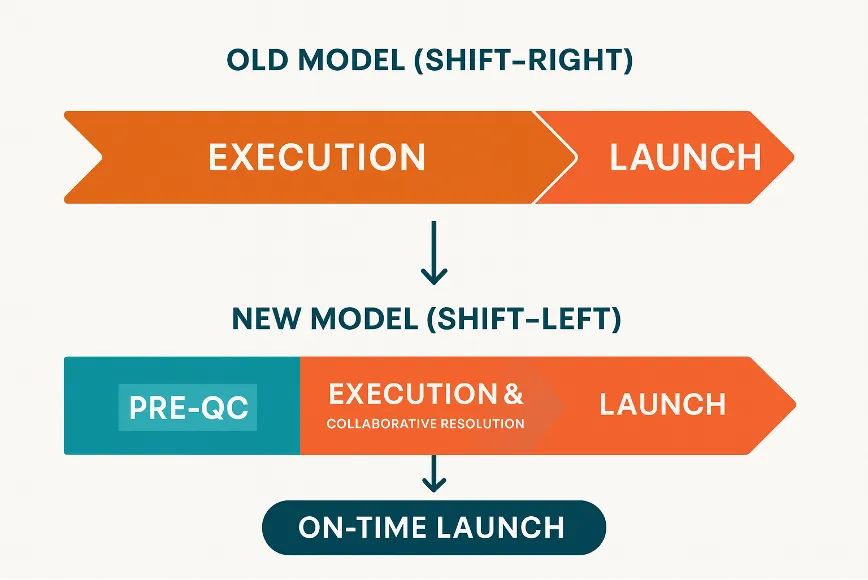
The first and most critical pillar involves moving quality assurance from the right (end) of the process to the far left (beginning).
The Pre-QC Process: Immediately upon ticket receipt, a dedicated Pre-QC Analyst conducts a thorough audit of the client brief and all assets against a standardized checklist (e.g., image dimensions, link functionality, audience definition, copy approval).
The Goal: To identify all potential issues within the first hour of a project, creating a valuable buffer of time for resolution instead of a last-minute panic.
4.2 Pillar 2: Structured & Transparent Communication -- The "No Surprise" Protocol
Visibility is useless unless it is shared. The second pillar mandates proactive, standardized communication.
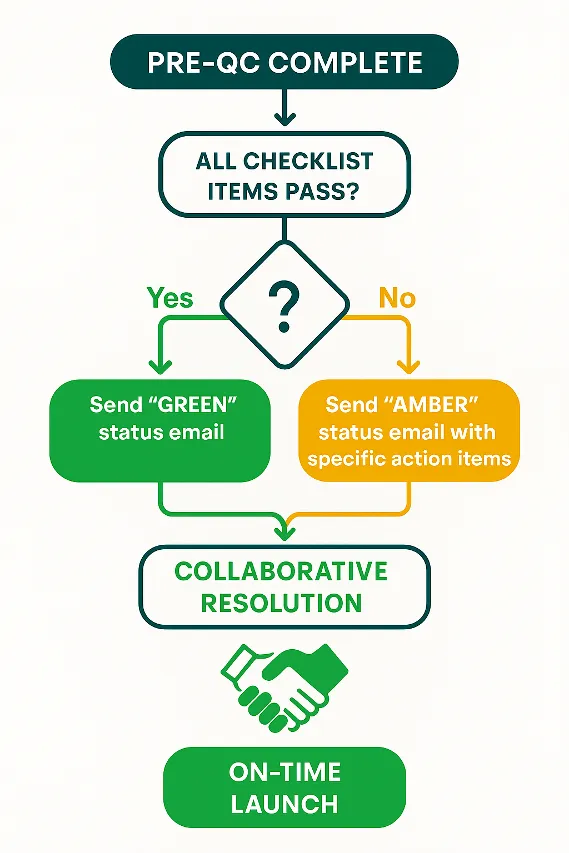
The Status Email Framework: Within 1 business hour of Pre-QC, a standardized email is sent to AMs and clients.
- Green Status (✅): "We have everything we need. On track for on-time launch."
- Amber Status (⚠️): "We've found X issues. Please provide Y by Z time to avoid delay."
- Proactive Delay Management: If an issue will impact the timeline, a new deadline is communicated immediately with a clear explanation. This manages expectations and demonstrates control, even in a setback.
4.3 Pillar 3: Collaborative, Parallelized Resolution -- Breaking Down Silos
The framework breaks down the walls between Operations, Account Management, and the Client.
- From Blame to Partnership: By instantly notifying AMs of issues with specific, actionable details, the Pre-QC process transforms resolution from a solitary burden on Ops into a shared mission. The AM can now engage the client in parallel to obtain missing items.
- Shared Responsibility: The narrative shifts from "Why didn't you give us this?" to "We found a potential hurdle early; let's solve it together quickly." This fosters a collaborative instead of adversarial dynamic.
5. The Technology Enabler: The Role of the Shared Dashboard
A shared project management dashboard (e.g., Jira, Asana, Smartsheet) is the central nervous system of this framework.
Function: It provides real-time status updates ("Pre-QC Complete", "Awaiting Client Input", "On Track"), making the process visible to all stakeholders.
Impact: It eliminates the need for repetitive status update emails and serves as the single source of truth, reinforcing the culture of transparency.
6. Measuring Impact: Quantifying the Value of Trust
The implementation of the Zero Surprise Delivery framework delivered measurable value across operational, client, and cultural dimensions.
7. Analysis: Key Success Factors and Implementation Challenges
7.1 Success Factors:
- Leadership Buy-in: This is a cultural change that requires full support from leadership to mandate new processes.
- Dedicated Resource: The Pre-QC role is critical and must be a dedicated function, not an added task for an already busy team member.
- Standardization: Checklists and email templates must be non-negotiable to ensure consistency.
- Technology Investment: A shared dashboard is essential for real-time visibility and is the backbone of the framework.
7.2 Implementation Challenges:
- Initial Resistance: Teams may resist the perceived "extra step" of Pre-QC. Overcoming this requires clear communication of the long-term time savings and stress reduction.
- Client Education: Clients must be onboarded to the new communication protocol to understand the value of the Amber status emails.
8. Conclusion: Reliability as the Ultimate Competitive Advantage
The "Zero Surprise Delivery" framework demonstrates that the most valuable deliverable for a digital operations team is not just a flawlessly executed campaign—it is trust. By institutionalizing transparency, proactively managing expectations, and fostering collaboration, organizations can escape the costly cycle of reactive firefighting. They can build a reputation for unparalleled reliability that becomes their strongest competitive advantage, leading to higher client retention, more strategic partnerships, and a more engaged and productive team. In an era where trust is the ultimate currency, Zero Surprise Delivery is the blueprint for earning it.
9. Appendix: Starter Kit for Implementing Zero Surprise Delivery
- Pre-QC Checklist Template: A sample checklist for a digital marketing campaign (covering assets, links, targeting, copy, etc.).
- Standardized Email Templates: Drafts for Green Status and Amber Status emails.
- Dashboard Setup Guide: Key statuses and fields to create in a tool like Jira or Asana.
- Rollout Communication Plan: A guide for announcing the new framework to internal teams and clients.
Case study: Digital marketing operations team · 100% on-time delivery, 35% NPS increase DOWNLOAD PDF VERSION