
Breaking the Static Barrier

📑 Table of Contents
- 1. Executive Summary
- 2. Introduction: The Dawn of Hyper-Personalized Advertising
- 3. The Strategic Imperative: Moving Beyond the "One-Size-Fits-All" Banner Ad
- 4. The Pre-Implementation Challenge: A Perfect Storm of Complexity
- 5. The Architectural Framework: A Three-Phase Implementation Methodology
- 6. The Payoff: Quantifying the Impact of Personalization
- 7. Analysis: Key Success Factors and Enduring Lessons
- 8. The Evolution: DCO in the Modern Privacy-Centric Era
- 9. Conclusion: Personalization as a Sustainable Competitive Advantage
- 10. Appendix: Glossary of Key Technical Terms
1. Executive Summary
In an era of advertising saturation, consumer attention is the ultimate currency. Static, generic banner ads have diminishing returns. This white paper details a pioneering project from 2018 that successfully implemented a large-scale Dynamic Creative Optimization (DCO) solution, enabling an advertiser to serve personalized ads based on a user's language, geolocation, and audience segment in real-time.
The initiative faced significant hurdles: a publisher unfamiliar with advanced ad tech, an advertiser reliant on external agencies, and the technical complexity of a server-to-server integration. Through a meticulous three-phase approach—encompassing discovery, stakeholder alignment, and technical execution—the team architected a solution using key-value pairs and macros within Google Ad Manager (GAM) and Campaign Manager (CM), integrated with a Data Management Platform (DMP).
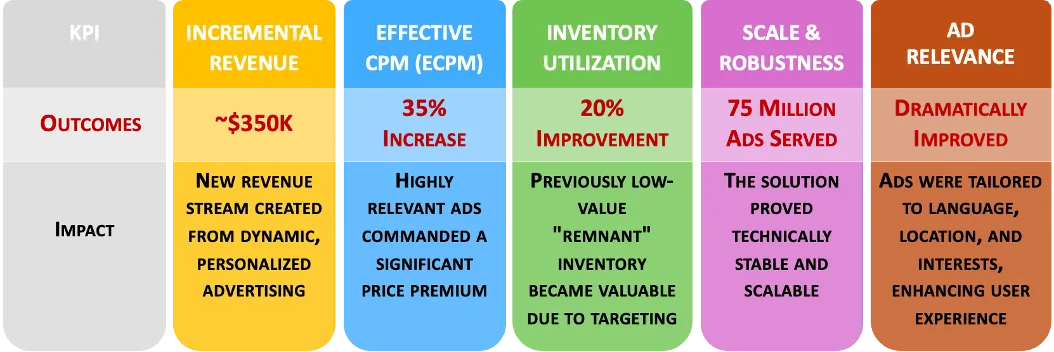
The results were transformative: $350K in incremental revenue, a 35% increase in eCPM, and 75 million dynamically served ads. This paper serves as a historical case study and a foundational blueprint, demonstrating that even in a complex ecosystem, technical ingenuity and rigorous project management can unlock the power of personalization, driving unprecedented value for both publishers and advertisers.
2. Introduction: The Dawn of Hyper-Personalized Advertising
The digital advertising landscape of 2018 was at an inflection point. Advertisers were beginning to understand that the future lay not in shouting a single message to a mass audience, but in whispering a relevant one to an individual.
Dynamic Creative Optimization (DCO) emerged as the technology to make this possible, allowing for the real-time assembly of ad creative tailored to a specific user. However, the path to implementation was fraught with technical and operational complexity, requiring a deep integration of data and systems that many players in the ecosystem were not prepared for. This case study examines one of the early successful large-scale implementations, providing a masterclass in navigating these challenges.
3. The Strategic Imperative: Moving Beyond the "One-Size-Fits-All" Banner Ad
The advertiser's goal was strategic: to increase ad relevance and performance by moving beyond static creative. The hypothesis was that an ad for a sports car shown to an "auto enthusiast" in Paris, in French, would outperform a generic English ad for a minivan. This required a fundamental shift from a creative-centric model to a data-driven, dynamic creative model.
4. The Pre-Implementation Challenge: A Perfect Storm of Complexity
The project's success is best understood by appreciating the significant challenges that were overcome.
4.1. The Knowledge Gap: Publisher Inexperience
The publisher's ad ops team was proficient in direct-sold, static banners. Concepts like key-value pairs, macros, and DMPs were entirely new, creating a steep learning curve and initial resistance.
4.2. The Resource Gap: Advertiser Limitations
The advertiser provided the strategy and creative variants but lacked in-house technical expertise, relying on a trading desk. This placed the entire burden of technical solutioning and integration on our implementation team.
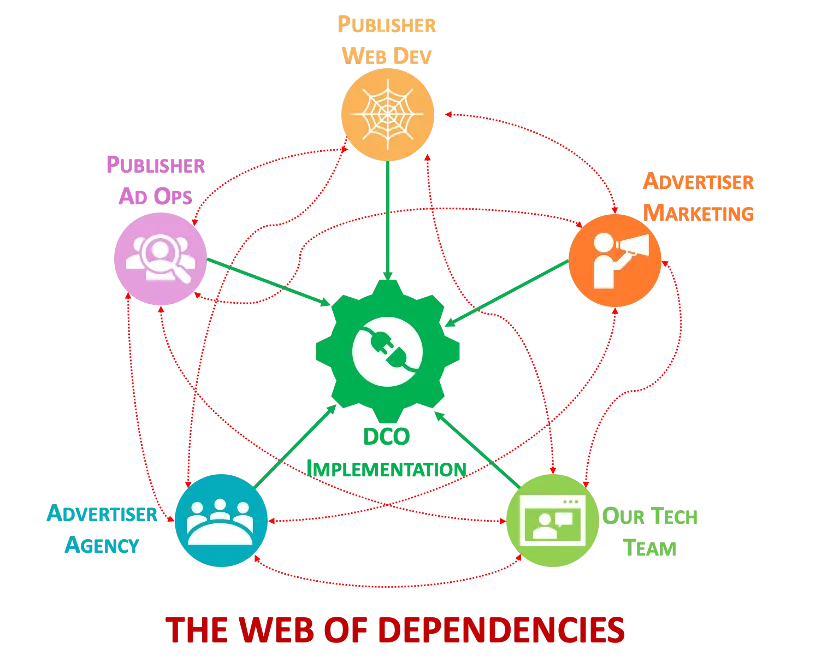
4.3. The Coordination Challenge: Managing a Five-Team Ecosystem
Success hinged on the seamless collaboration of five distinct teams with different priorities, expertise, and languages (technical vs. business).
5. The Architectural Framework: A Three-Phase Implementation Methodology
To manage this complexity, the project was structured into three distinct, sequential phases.
- Phase 1: Discovery & Environment Analysis
- Phase 2: Stakeholder Alignment & Process Definition
- Phase 3: Technical Deep Dive & Execution
5.1 Phase 1: Discovery & Environment Analysis — Laying the Groundwork
This phase was dedicated to understanding the technical landscape.
- Publisher Audit: A deep dive into the publisher's GAM instance, ad tags, and website architecture.
- Advertiser Workflow Mapping: Understanding how the advertiser trafficked campaigns through Google Campaign Manager (CM).
- Outcome: A clear assessment of technical readiness and a gap analysis.
5.2 Phase 2: Stakeholder Alignment & Process Definition — The Human Engine
Technology is only as effective as the people and processes behind it. This phase focused on creating clarity and accountability.
- Bridging the Knowledge Gap: We created simplified, non-technical documentation to explain the "what" and "why" of DCO to the publisher's team, turning skepticism into buy-in.
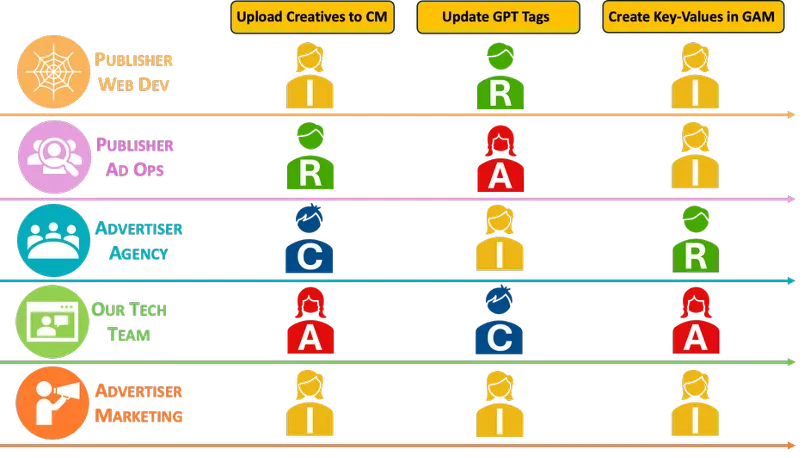
- The RACI Matrix: A Responsible, Accountable, Consulted, Informed (RACI) chart was developed for every single task. This eliminated ambiguity and established clear ownership across the five teams.
5.3 Phase 3: The Technical Deep Dive — Building the Dynamic Ad Engine
This was the core technical implementation, a sophisticated dance of data passing and system integration.
5.3.1 Component 1: The Key-Value Hierarchy in GAM
Key-value pairs are like labels that categorize information. We set up a structured system in GAM:
loc=nyc (Geolocation: New York City) | lang=fr (Language: French) | audience=auto_intent (Audience Segment: Auto Intender)
5.3.2 Component 2: The Magic of Macros — Passing Data Without Breaking Silos
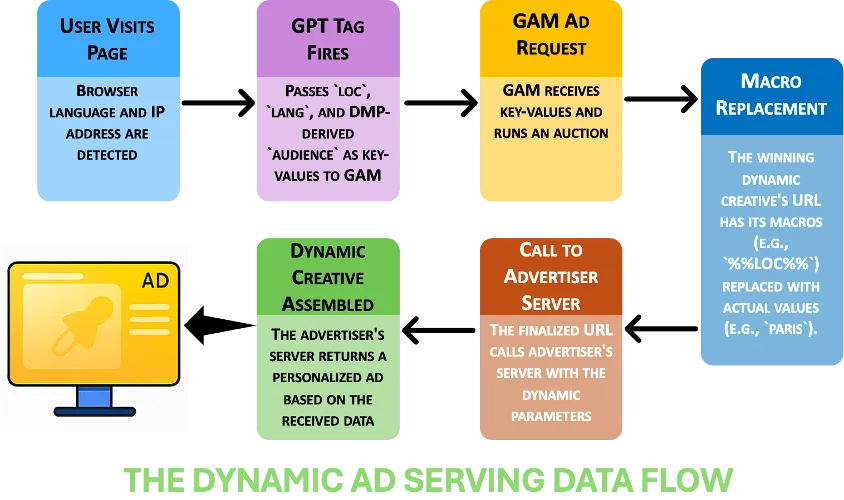
This was the most critical technical component. Due to privacy, GAM cannot send user data directly to an advertiser's server. The solution was macros — special placeholders in the ad tag.
How it worked: The advertiser's creative in CM was set up with a URL like: https://advertiser.com/serve?city=%%CITY%%
When GAM received an ad request for a user in Paris, it replaced %%CITY%% with paris automatically.
The final call to the advertiser's server was: https://advertiser.com/serve?city=paris
The advertiser's server then used this data to assemble the appropriate creative.
5.3.3 Component 3: Data Integration — Tapping into the DMP
To power audience targeting, we integrated the publisher's Salesforce Krux DMP with GAM. The DMP, which analyzed user behavior on the site to assign segments (e.g., "value_123" for auto enthusiasts), synced these segments into GAM as key-values, making them available for macro-passing.
6. The Payoff: Quantifying the Impact of Personalization
The implementation delivered staggering financial and strategic value, proving the hypothesis that personalization drives performance.

7. Analysis: Key Success Factors and Enduring Lessons
- Macros Were the Hero: In a pre-API-dominated world, macros were the elegant, standardized solution for bypassing data silos without violating privacy.
- Process Overrides Technology: The RACI matrix and clear documentation were not ancillary; they were the bedrock of success in a multi-team environment.
- Education is a Strategic Investment: Taking time to educate non-technical stakeholders transformed them from obstacles into allies.
- Dynamic Creative is a Win-Win-Win: The advertiser gets better performance, the publisher gets higher revenue, and the user sees more relevant ads.
8. The Evolution: DCO in the Modern Privacy-Centric Era
While the macro-based technique remains relevant, the ad tech landscape has evolved. The deprecation of third-party cookies and increased privacy regulations (GDPR, CCPA) have shifted the focus towards:
- First-Party Data Strategies: Leveraging publisher and advertiser-owned data with clear consent.
- Contextual Targeting: Personalizing based on page content rather than user data.
- Privacy-Compliant Identifiers: Using solutions like Google's Privacy Sandbox.
The core principle—using data to assemble relevant creative in real-time—is more important than ever, even as the sources of that data change.
9. Conclusion: Personalization as a Sustainable Competitive Advantage
This case study from 2018 stands as a testament to the enduring power of personalized advertising. It demonstrates that with technical expertise, meticulous project management, and a clear strategic vision, organizations can overcome significant complexity to build capabilities that deliver lasting competitive advantage. The lessons learned in orchestrating teams, designing elegant technical solutions, and measuring impact are universally applicable. As we move into a privacy-first future, the imperative for relevance remains, and the foundational principles outlined in this paper will continue to guide successful implementations.
10. Appendix: Glossary of Key Technical Terms
- DCO (Dynamic Creative Optimization): Technology that assembles and serves personalized ad creative in real-time based on data signals.
- Key-Value Pair: A method for labeling data (e.g.,
city=chicago). - Macro: A placeholder in an ad tag that is automatically replaced with a dynamic value (e.g.,
%%CITY%%). - GAM (Google Ad Manager): A publisher-side ad server that manages the delivery of advertisements.
- CM (Campaign Manager): An advertiser-side ad server for trafficking and tracking campaigns.
- DMP (Data Management Platform): A system that collects and manages audience data from various sources.
Case study: 2018 large-scale implementation · $350K incremental revenue, 35% eCPM lift DOWNLOAD PDF VERSION