
Unlocking Premium Inventory Value

📑 Table of Contents
- 1. Abstract & Executive Summary
- 2. Introduction: The Evolving Digital Advertising Landscape (2018-2019)
- 3. The Core Challenge: Inefficient Monetization of Premium Inventory
- 4. Case Study: A Prominent Real Estate Publisher
- 5. The Strategic Framework: A Four-Pillar Optimization Methodology
- 6. Implementation: From Strategy to Actionable Steps
- 7. Quantified Results & Business Impact
- 8. Conclusion & Forward-Looking Strategies
1. Abstract & Executive Summary
In the late 2010s, many premium publishers found themselves caught between legacy ad serving systems and the new paradigm of header bidding. This white paper details a successful yield optimization project for a leading real estate publisher that, despite having high-value traffic, suffered from stagnant revenue due to a suboptimal Google Ad Manager (GAM) and Ad Exchange (AdX) setup.
By employing a sophisticated, data-driven strategy that mimicked the effects of header bidding within GAM's native framework, we achieved a 73% revenue growth and a 30% increase in effective CPM (eCPM). This paper outlines the four-pillar methodology used: introducing artificial competitive pressure, re-architecting the waterfall, implementing granular inventory segmentation, and activating first-party data. The results demonstrate that significant revenue gains are achievable through expert configuration and continuous optimization, even before a full-scale technological overhaul.
2. Introduction: The Evolving Digital Advertising Landscape (2018-2019)
The digital advertising ecosystem was in a state of rapid transition. Header bidding had emerged as a powerful technology, creating unified auctions that forced demand sources to compete simultaneously, thereby driving up prices for publishers. However, adoption was not universal. Many established publishers, like the real estate publisher in this study, relied heavily on Google Ad Manager's "waterfall" model.
In this legacy model, ad requests were sent to demand partners sequentially based on pre-set priorities. High-priority, guaranteed direct sales were served first, followed by lower-priority networks and exchanges like AdX. The critical flaw was the lack of real-time competition; AdX had no incentive to bid aggressively if it knew it was only competing against low-yield remnant networks. This resulted in premium inventory being undersold.
3. The Core Challenge: Inefficient Monetization of Premium Inventory
3.1. The Limitations of the Legacy Waterfall
The traditional waterfall is a static hierarchy. Once a high-priority line item (e.g., a direct campaign) is passed over for any reason (e.g., targeting mismatch), the opportunity cascades down to lower tiers. This often meant that high-value impressions from users actively researching property investments were being filled by low-CPM remnant demand because the setup lacked the mechanism to return to a higher-paying source.
3.2. The Header Bidding Disruption
Header bidding solved this by sending ad requests to multiple demand partners simultaneously before making a call to the ad server. The highest bid from the header bidding wrapper would then be sent to GAM as a price floor, forcing AdX to compete. Our challenge was to replicate this competitive environment without a header bidding wrapper in place.
4. Case Study: A Prominent Real Estate Publisher
4.1. Background and Pre-Optimization Audit
The publisher, a leader in real estate news and listings, generated millions of pageviews monthly from a high-intent audience. Despite this premium traffic, their ad revenue was flat. A technical audit revealed:
- No header bidding implementation.
- A cluttered, inefficient GAM waterfall with over 100 line items.
- AdX placed too low in the priority stack, often blocked by non-guaranteed line items.
- Uniform price floors applied across all site content, from the homepage to archive pages.
4.2. In-Depth Diagnosis of Monetization Leakage
We identified three primary sources of revenue leakage:
- Low Demand Competition: AdX was operating in a vacuum, leading to bid stagnation.
- Unsegmented Inventory: Premium placements (e.g., homepage mastheads) were sold at the same price as standard banners.
- Inefficient Waterfall Setup: Static price floors and incorrect line item priorities prevented high-yield demand from accessing the best inventory.
5. The Strategic Framework: A Four-Pillar Optimization Methodology
Our solution was built on four interconnected pillars designed to systematically address each challenge.
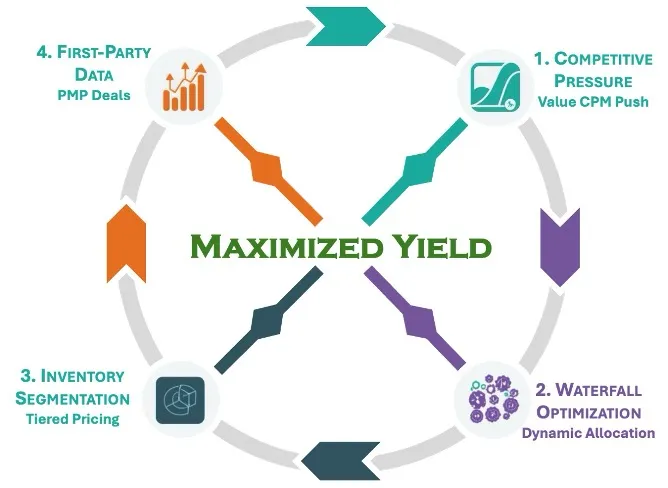
5.1 Pillar 1: Simulating Competitive Pressure & Value CPM Push
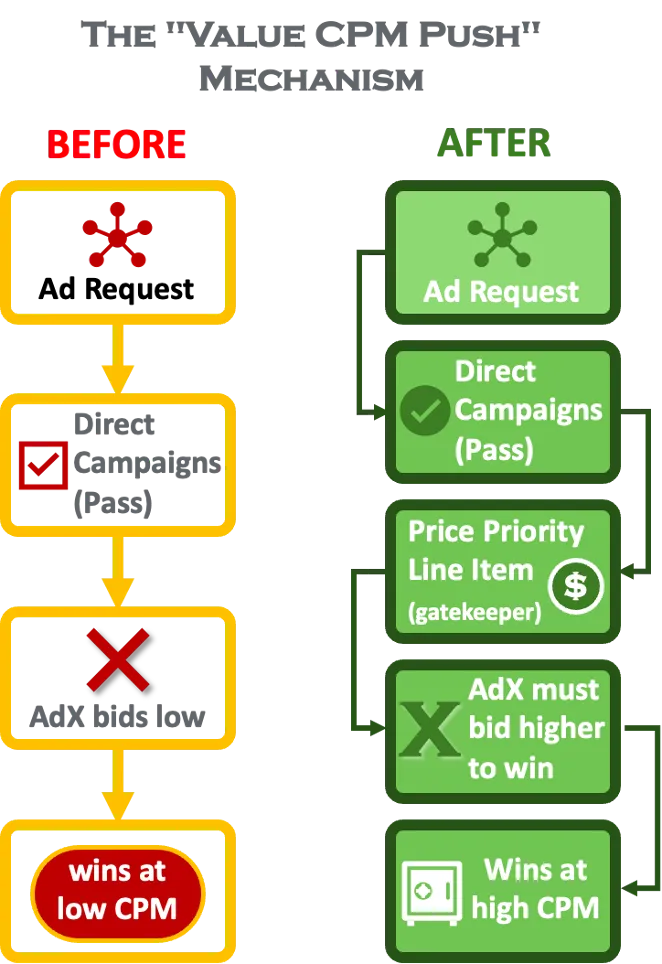
Concept: To force AdX to bid higher, we needed to create competition. We analyzed historical winning bid data from other programmatic exchanges integrated via waterfall (e.g., Index Exchange, PubMatic).
Action: We created a series of "dummy" price priority line items in GAM with CPM floors set 20-30% above the historical clears from these exchanges. These line items acted as "gatekeepers." For AdX to win the impression, it had to beat this artificially inflated floor, effectively training its algorithm to bid more aggressively.
5.2 Pillar 2: Waterfall Architecture & Dynamic Allocation Mastery
Concept: Proper line-item hierarchy is critical for balancing direct-sold campaign delivery with programmatic yield.
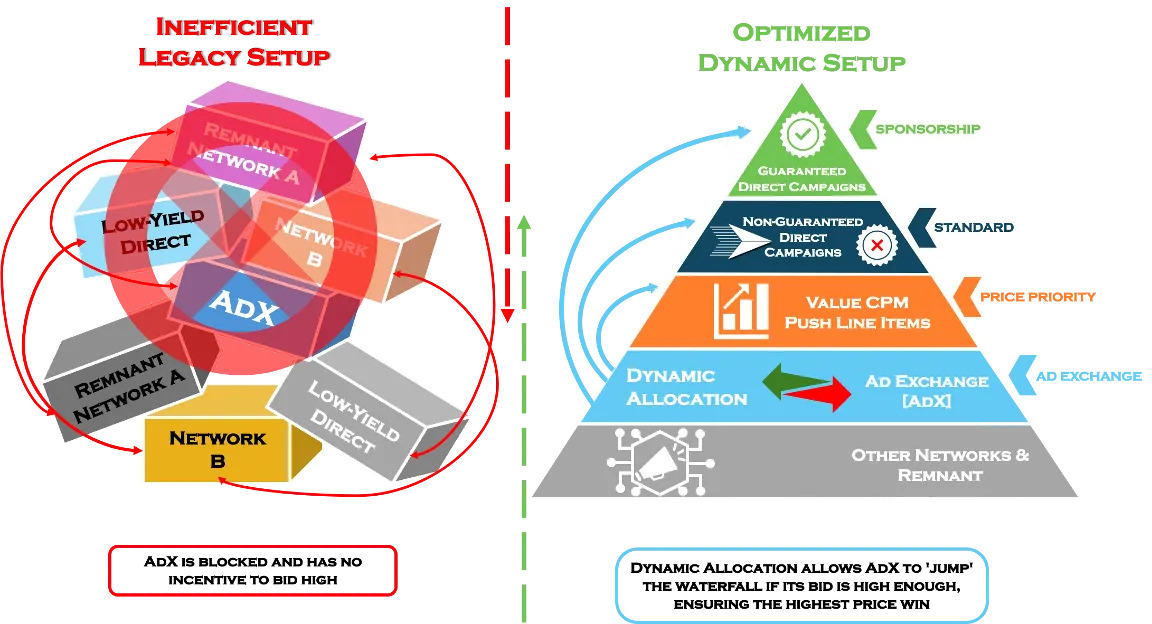
Action: We reorganized the waterfall into a logical order:
- Sponsorship (guaranteed),
- Standard (guaranteed),
- Price Priority (Value CPM Push line items),
- AdX (with Dynamic Allocation enabled),
- Other Networks.
Enabling Dynamic Allocation was crucial, as it allows AdX to "jump" the waterfall and compete with higher-priority line items if its bid exceeds their effective CPM.
5.3 Pillar 3: Granular Inventory Segmentation & Pricing Tiers
Concept: Not all impressions are created equal. A user on the homepage has a different value than a user reading a three-year-old blog post.
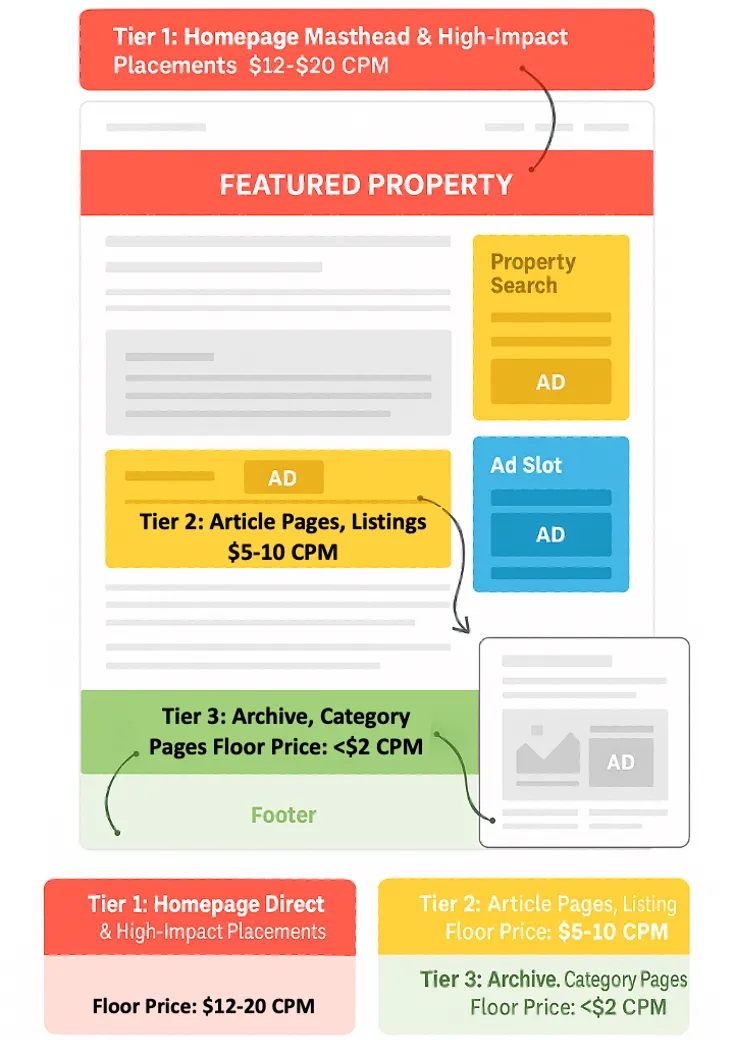
Action: Using GAM reporting and Google Analytics data, we segmented inventory into three tiers:
- Tier 1 (Premium): Homepage, Property Search Results. Applied high floor prices ($8-15+).
- Tier 2 (High-Quality): Article Pages, Market Reports. Applied medium floor prices ($4-8).
- Tier 3 (Remnant): Archive Pages, Category Pages. Applied low/no floor prices.
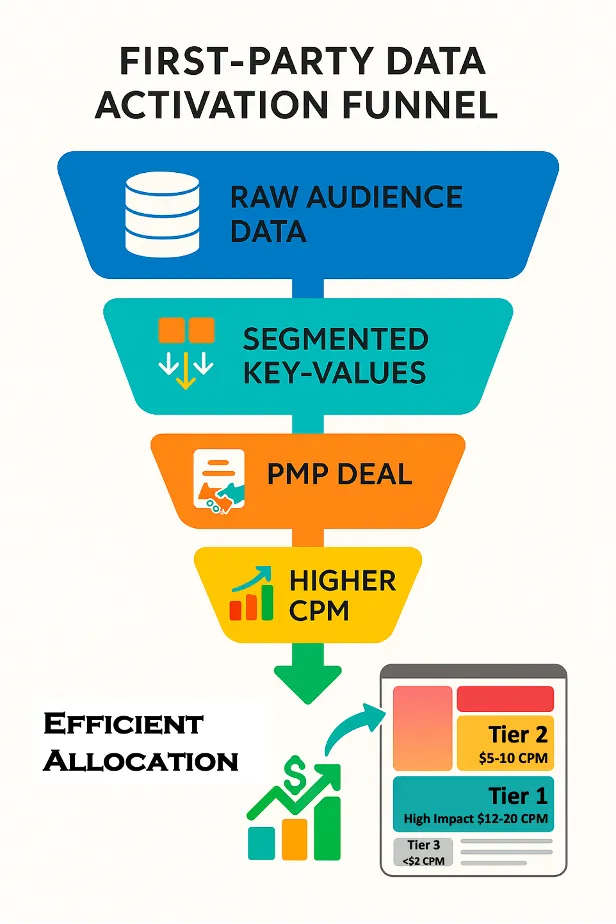
5.4 Pillar 4: Leveraging First-Party Data for Premium Deals
Concept: The publisher's audience data was an untapped asset. Advertisers pay a premium to reach defined, high-intent audiences.
Action: We packaged audience segments (e.g., "Luxury Property Seekers," "First-Time Home Buyers") into targetable key-values within GAM. We then created curated Private Marketplace (PMP) deals around these segments, offering them directly to demand-side platforms (DSPs) and agencies. This created a high-CPM, brand-safe demand channel.
6. Implementation: From Strategy to Actionable Steps
Success depended on continuous monitoring and adjustment.
- Daily CPM Analysis: Automated reports tracked win rates and clear prices for all demand partners. Floors were adjusted weekly to maintain an optimal balance between aggressiveness and achievability.
- Exchange Collaboration: Quarterly Business Reviews (QBRs) with exchange partners ensured their bidders were properly configured and helped identify new demand trends.
7. Quantified Results & Business Impact
The implementation of this four-pillar strategy yielded dramatic, quantifiable results within six months:
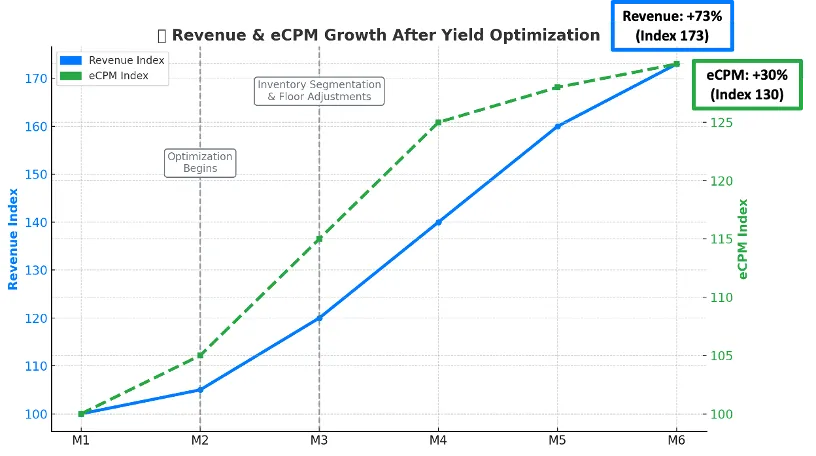
Interpretation: The average revenue per thousand impressions skyrocketed, proving the strategy successfully increased the value of the publisher's inventory.
Overall Revenue Growth: +73%
Interpretation: The eCPM growth was not achieved at the expense of volume. The optimized waterfall and dynamic allocation maintained a high fill rate, leading to a substantial increase in total earnings.
Improved Demand Competition: AdX win rates adjusted, but its average bid price increased significantly, indicating healthier competition.
8. Conclusion & Forward-Looking Strategies
This case study demonstrates that sophisticated yield optimization within existing ad server frameworks can produce header bidding-like results. By applying a methodical, data-driven approach to competitive pressure, waterfall structure, inventory segmentation, and data activation, publishers can unlock significant hidden revenue.
Looking forward, the principles remain relevant, but the tactics evolve. The next steps for a publisher at this stage would include:
- Implementing Header Bidding: To create a true, unified auction.
- Adopting Unified Pricing: Applying a single, holistic price floor across all demand sources.
- Exploring Seller-Defined Audiences: A privacy-centric future for first-party data activation.
Case study: Leading real estate publisher · +73% revenue, +30% eCPM DOWNLOAD PDF VERSION