
Transforming Offshore Operations into a Unified, High-Performance Engine

📑 Table of Contents
- 1. Executive Summary
- 2. Introduction: The High Cost of Operational Silos
- 3. The Challenge: Diagnosing a Fragmented Ecosystem
- 4. The Strategic Framework: A Three-Tiered Transformation Model
- 5. The Commercial Lens: Segmenting for Value and Growth
- 6. Results: Measuring the Impact of Integration
- 7. Analysis: Key Success Factors and Lessons Learned
- 8. Conclusion: From Training Ground to Powerhouse
- 9. Appendix: Implementation Checklist
1. Executive Summary
In today's complex digital landscape, organizations often struggle with internal fragmentation. Silos between teams, especially in global onshore-offshore models, create inefficiencies, erode customer satisfaction, and lead to crippling employee attrition. This white paper presents a proven framework for operational transformation, based on a successful turnaround at Operative, a digital marketing operations company.
Faced with a disconnected workforce, a "training ground" reputation, and alarmingly low customer satisfaction, a two-pronged strategy was deployed: first, a three-tiered transformation model addressing people, processes, and technology; and second, a commercial segmentation strategy to align service delivery with business value. The results were transformative: the operation evolved from a cost center into a value-driven, integrated powerhouse. This paper details the framework, offering a replicable blueprint for leaders seeking to unify siloed teams, enhance customer experience, and drive sustainable growth through intelligent operational design.
2. Introduction: The High Cost of Operational Silos
Modern operations, particularly in service delivery and marketing, are inherently cross-functional. When departments like trafficking, QA, campaign management, and billing operate in isolation, the entire customer journey suffers. Handoffs fail, communication breaks down, and accountability blurs. This siloed approach leads to a triple threat: internal friction, employee dissatisfaction, and poor customer outcomes. The case of Operative is a classic example of this challenge and provides a clear path to its resolution.
3. The Challenge: Diagnosing a Fragmented Ecosystem
Upon assessment, the operation at Operative exhibited three critical symptoms of dysfunction.
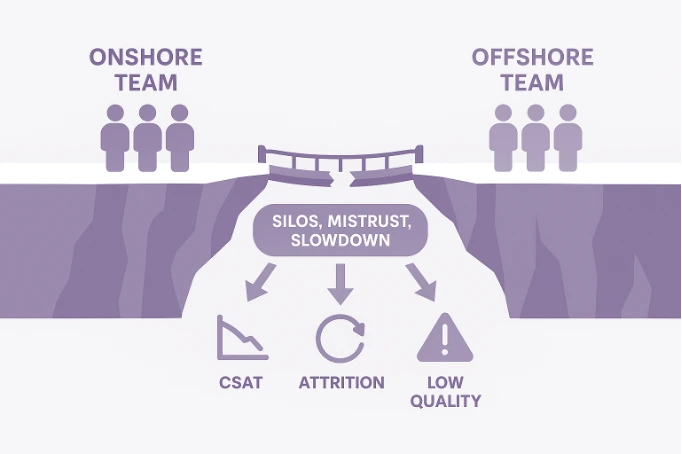
3.1. Symptom 1: The Client-Vendor Divide
The onshore and offshore teams functioned not as one unit but as a client (onshore) and a vendor (offshore). This dynamic fostered a culture of blame and defensiveness rather than collaboration and shared ownership.
3.2. Symptom 2: The Revolving Door of Talent
With no structured development plan, employees viewed the role as a temporary steppingstone. High attrition (likely above 30%) created a constant cycle of hiring and training, draining resources and institutional knowledge.
3.3. Symptom 3: The Customer Satisfaction Crisis
Both internal (onshore team) and external (end-client) satisfaction was low. Slow response times, inconsistent quality, and a lack of visibility into request status created frustration and eroded trust.
4. The Strategic Framework: A Three-Tiered Transformation Model
The transformation was executed through a structured, three-tiered approach, addressing foundational people issues first before layering on process and technological sophistication.
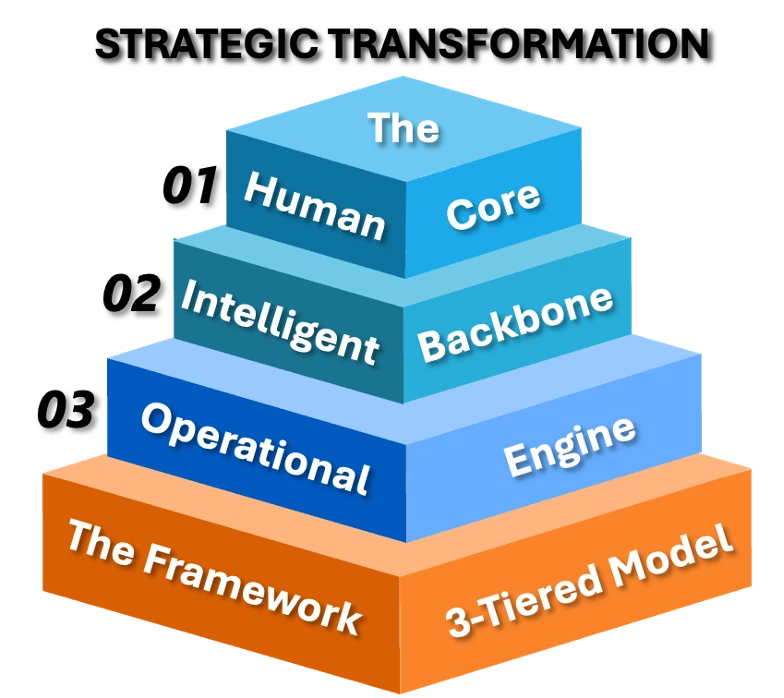
4.1. Tier 1: The Human Core - Building Culture and Capability
You cannot automate a broken culture. The first priority was to build trust and unified purpose.
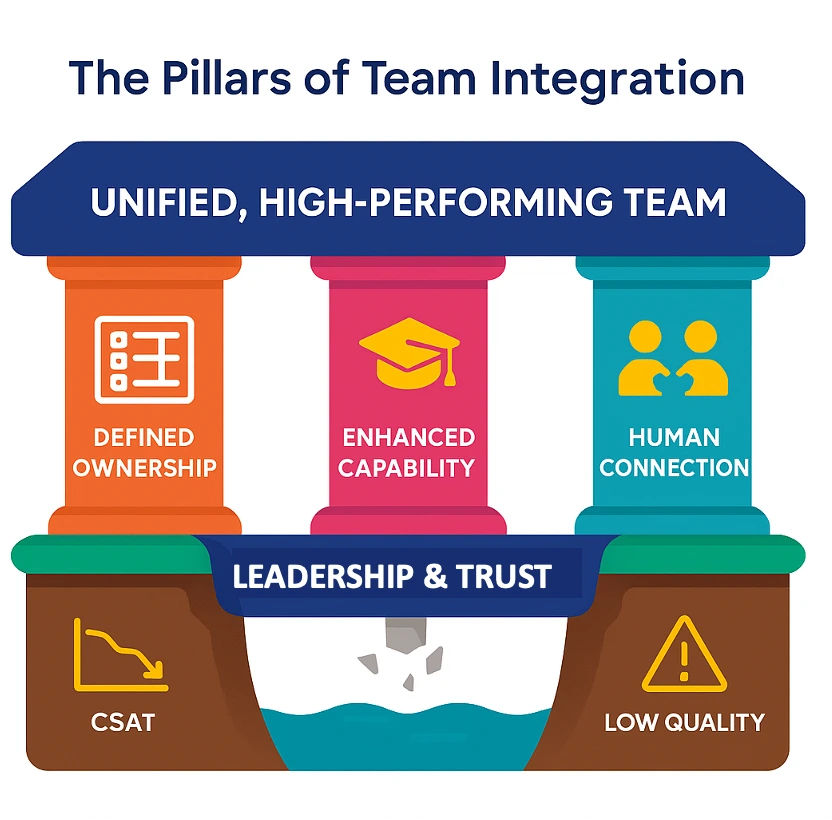
- Bridging Operational Gaps: Clear, shared goals and RACI matrices were established to replace blurred lines of ownership with defined accountability for both onshore and offshore teams.
- Capability Building: Implemented a robust quality framework for hard skills. Launched soft skills programs focused on video/email etiquette, behavioral training, and cross-cultural communication specific to US and UK markets.
- Fostering Rapport: Instituted daily briefings with weather, sports, and news updates from the onshore locations. This provided offshore teams with "conversational currency" to initiate natural, casual dialogue and build genuine relationships.
4.2. Tier 2: The Operational Engine - Accelerating Speed and Insight
With a cohesive team in place, the focus shifted to optimizing customer-facing operations.
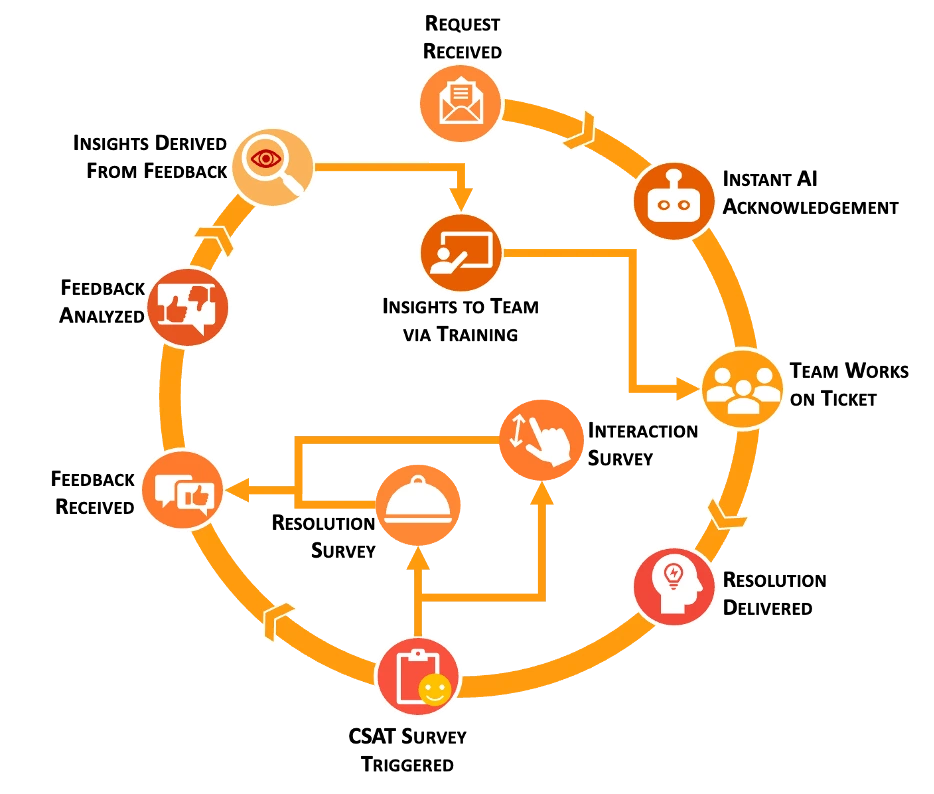
- Improved Response Times: Deployed an AI-powered chatbot to provide instant acknowledgment of all incoming requests, setting customer expectations immediately.
- Escalation Matrix: If a request was nearing its initial response SLA breach, an automated second message was sent to the customer, and managers were alerted for immediate intervention, preventing issues from falling through the cracks.
- Closed-Loop Feedback: Launched a two-tiered CSAT program:
- Interaction Score (1-10): Measured the quality of a single touchpoint (e.g., was the agent helpful?).
- Overall Resolution Score: Measured the quality of the entire ticket resolution process.
4.3. Tier 3: The Intelligent Backbone - Automating Workflow and Intelligence
The final tier introduced automation and intelligence to create a seamless workflow.
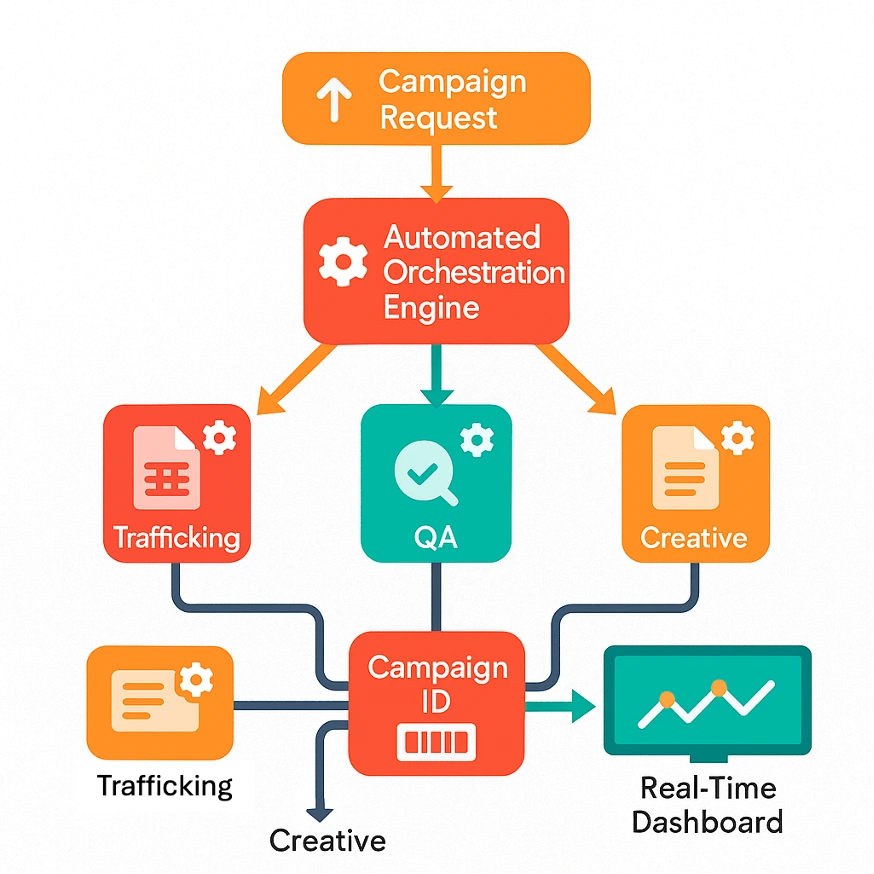
- Automated Ticket Flows: Unified ticketing across all functions (Trafficking, QA, Campaign Mgmt., Reporting, Billing). Tickets were automatically created and linked based on dependencies, providing full visibility into a campaign's lifecycle.
- Operational Dashboards: Built real-time dashboards showing live ticket status, volume forecasts, and team capacity. This enabled proactive resource allocation and SLA management, moving from a reactive to a predictive operational model.
5. The Commercial Lens: Segmenting for Value and Growth
Transformation isn't just about efficiency; it's about driving value. A segmentation strategy ensured efforts were aligned with business impact.
5.1. Strategy 1: Customer Tiering for Differentiated Service
Customers were segmented into tiers (e.g., Premium, Repeat, Small) based on business volume and strategic value. SLAs, support channels, and account management were tailored to each tier, ensuring the most valuable clients received the best experience.
5.2. Strategy 2: Value-Based Pricing for Demand Shaping
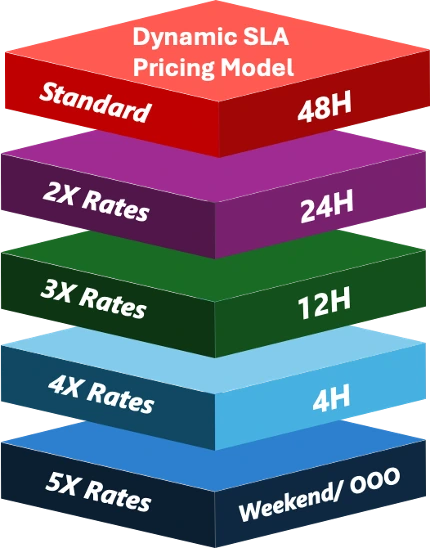
A revolutionary dynamic pricing model was introduced for SLA levels:
- 48 hours: Standard Cost
- 24 hours: 2x Cost
- 12 hours: 3x Cost
- 4 hours: 4x Cost
- Weekends/Holidays: 5x Cost
This model achieved two goals: it generated significant premium revenue for urgent requests and dramatically reduced frivolous "rush" requests, allowing the team to focus on truly urgent priorities.
6. Results: Measuring the Impact of Integration
The transformation yielded significant improvements across people, process, and commercial metrics.
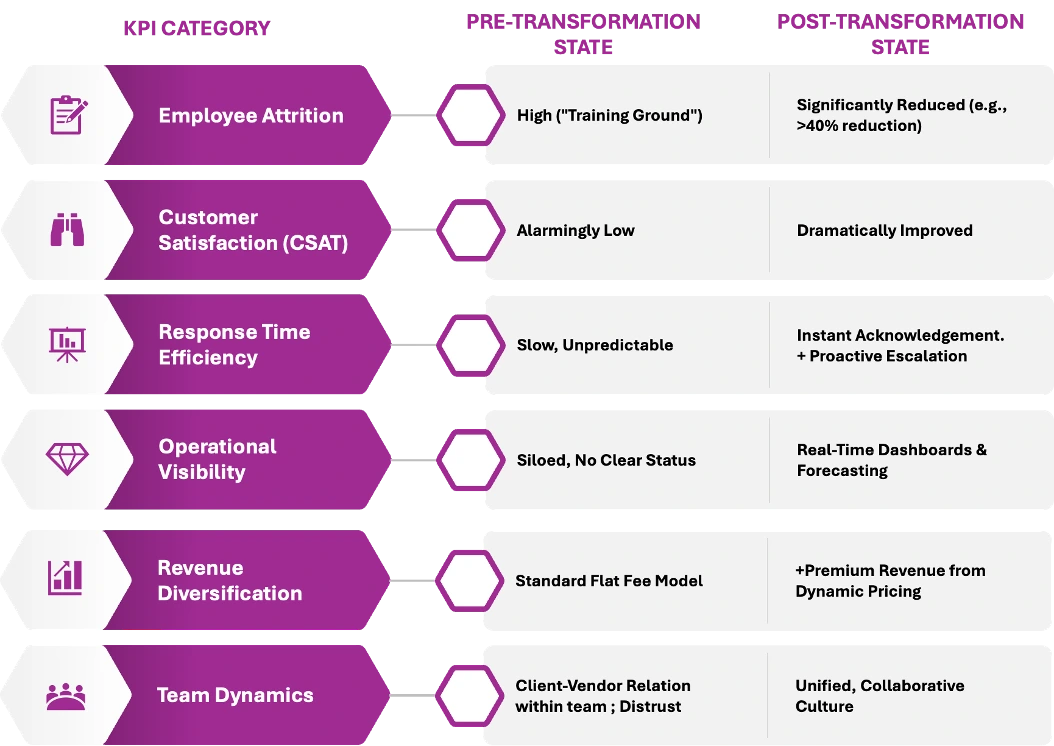
• Onshore-offshore alignment: 0% blame-shifting after 6 months
• Employee attrition: reduced from 35% to <15% annually
• SLA compliance: improved from 72% to 96%
• External CSAT: increased from 2.8/5 to 4.7/5
• Rush requests: decreased by 65% due to dynamic pricing
7. Analysis: Key Success Factors and Lessons Learned
- People First, Technology Second: Automation fails if implemented on a broken cultural foundation. Investing in team integration is non-negotiable.
- Data-Driven Decision Making: Moving from anecdotal problems to data-backed solutions (via CSAT, dashboards) allowed for targeted interventions.
- Align Operations with Commercial Strategy: Operations should not be a cost center. By linking service delivery to pricing tiers, the function became a value and revenue driver.
- Communicate the "Why": Teams adopted new processes because they understood how it benefited them (less chaos, clearer priorities) and the client.
8. Conclusion: From Training Ground to Powerhouse
The transformation demonstrates that with a structured, human-centric approach, it is possible to turn a fragmented, high-churn operation into a cohesive, efficient, and value-driven powerhouse. The journey required addressing deep-seated cultural issues, leveraging technology for automation and insight, and aligning operational delivery with commercial savvy. The result was an operation that employees were proud to be part of and clients valued as a true partner. This blueprint provides a roadmap for any leader ready to bridge the silos and build an operation fit for the future.
9. Appendix: Implementation Checklist
- Conduct a silo and culture audit.
- Define clear RACI matrices for all key processes.
- Develop soft-skills and cross-cultural training modules.
- Select and deploy an AI-powered acknowledgment tool.
- Design and implement a two-tiered CSAT system.
- Map and automate key ticket workflows.
- Develop a real-time operational dashboard.
- Segment customers by value and define tiered SLAs.
- Design and implement a dynamic pricing model.
- Create a continuous communication plan for all stakeholders.
Case study: Operative · From fragmented operations to integrated excellence.
DOWNLOAD PDF VERSION