
Building a Future-Ready MarTech Ecosystem

📑 Table of Contents
- 1. Executive Summary
- 2. Introduction: The Digital Imperative in Pharma
- 3. The Challenge: Fragmentation in the Face of Ambition
- 4. The Solution: A Strategic, Three-Pillar Framework for MarTech Maturity
- 5. Results & Measurable Impact
- 6. Analysis: Key Success Factors for Sustainable Transformation
- 7. Conclusion & Next Steps: The Journey to Continuous Maturity
- 8. Appendix: Technologies Deployed
1. Executive Summary
The global pharmaceutical industry stands at a crossroads, where digital-first customer engagement is no longer a luxury but a strategic necessity. This white paper details a proven framework for achieving MarTech maturity, based on a successful large-scale digital transformation program for a leading global pharmaceutical company.
Facing fragmented systems, significant compliance risks, and inefficient operations across 14 markets, the client embarked on a journey to build a unified, personalized, and compliant digital engagement engine. The solution was not merely technological but organizational, built on three core pillars:
(1) implementing an integrated, best-in-class MarTech stack.
(2) fostering seamless cross-functional and cross-geographical collaboration.
(3) executing a globally coordinated yet locally tailored rollout strategy.
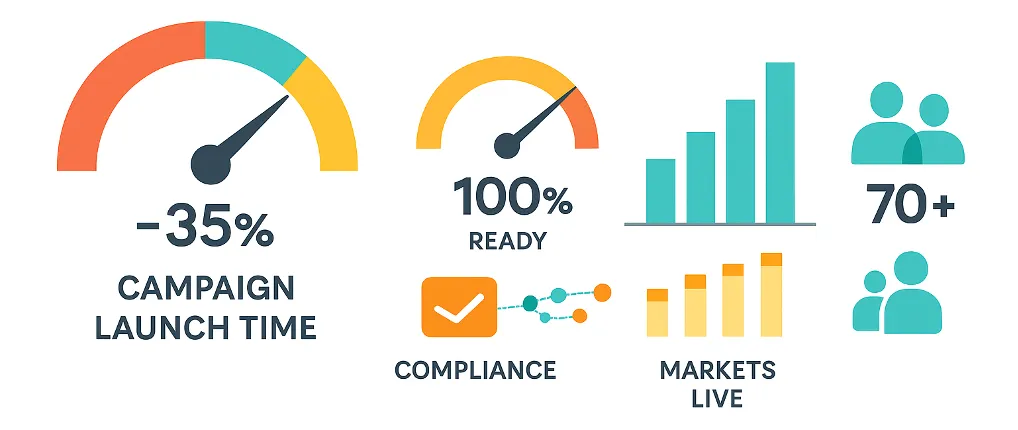
The results were transformative: a 35% reduction in campaign launch timelines, achievement of 100% GDPR/HIPAA readiness, and the enablement of true personalized omnichannel automation. This paper argues that success in pharmaceutical digital marketing hinges on treating MarTech as a business enabler, requiring deep alignment between global strategy and local execution, and a commitment to breaking down internal silos. The lessons herein provide a scalable blueprint for any life sciences organization aiming to modernize its marketing operations and secure a competitive advantage in the digital age.
2. Introduction: The Digital Imperative in Pharma
The pharmaceutical sector is undergoing a profound shift. The rise of digital-native healthcare professionals (HCPs) and empowered patients demands a new paradigm for engagement—one that is personalized, on-demand, and consistent across channels. Simultaneously, stringent regulatory frameworks like GDPR and HIPAA create a complex compliance landscape that can stifle innovation if not addressed proactively.
For global pharma companies with sprawling brand portfolios and diverse regional markets, the challenge is magnified. Legacy systems, inherited through mergers and acquisitions or built in isolation by local teams, often create a tangled web of technologies that cannot communicate. This leads to disconnected customer experiences, operational inefficiencies, and immense regulatory risk. Achieving MarTech maturity—the optimized and strategic use of marketing technology—is thus critical to driving growth, ensuring compliance, and delivering meaningful customer value.
3. The Challenge: Fragmentation in the Face of Ambition
Our client, a top-tier global pharma company with over 10 brands across Europe and North America, exemplified this challenge. Their ambition was clear: to deliver personalized, compliant, and scalable digital experiences. Their reality, however, was defined by fragmentation.
3.1. The Siloed Marketing Landscape
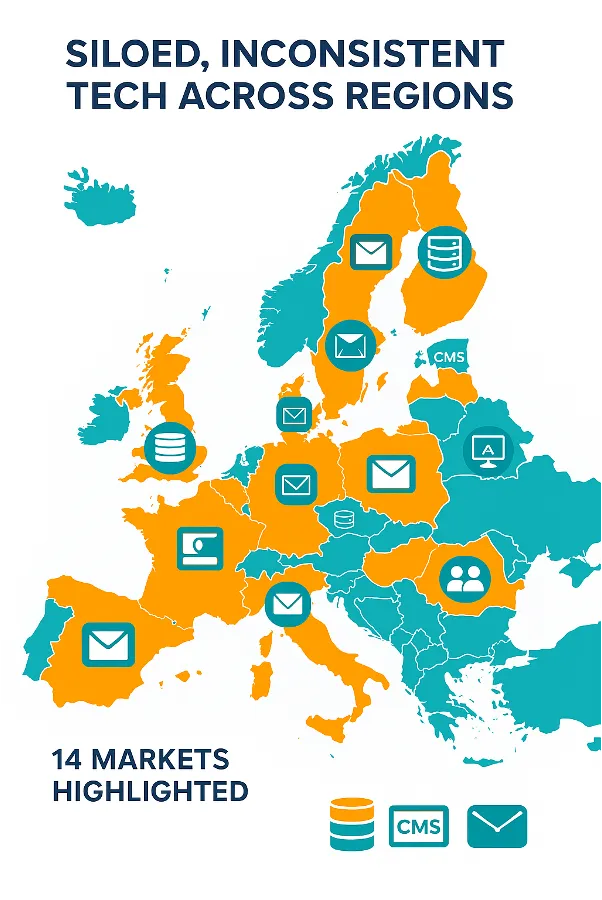
Each market operated as an independent entity, with its own preferred tools for email, web content, and data management. This lack of a centralized strategy resulted in:
- Inconsistent Brand Experiences: A customer interacting with Brand A in Germany would have a completely different digital journey than a customer interacting with the same brand in France or the UK.
- Data Silos: Valuable customer interaction data was trapped in disparate systems, making it impossible to build a single view of the customer or understand their journey across touchpoints.
3.2. The Compliance Abyss
With no centralized consent management mechanism, tracking and honoring user preferences for data collection and communication was a manual, error-prone process. This exposed the organization to significant financial and reputational risk under GDPR and HIPAA regulations.
3.3. The Inefficiency Tax
Marketing teams spent an inordinate amount of time on manual processes, data reconciliation, and navigating technical limitations rather than on strategic activities. Launching a simple omnichannel campaign was a slow, costly, and arduous undertaking.
4. The Solution: A Strategic, Three-Pillar Framework for MarTech Maturity
The transformation program was designed to address these challenges holistically, moving beyond a simple technology installation to a fundamental rewiring of marketing operations.
4.1. Pillar 1: Architecting a Future-Ready Technology Infrastructure
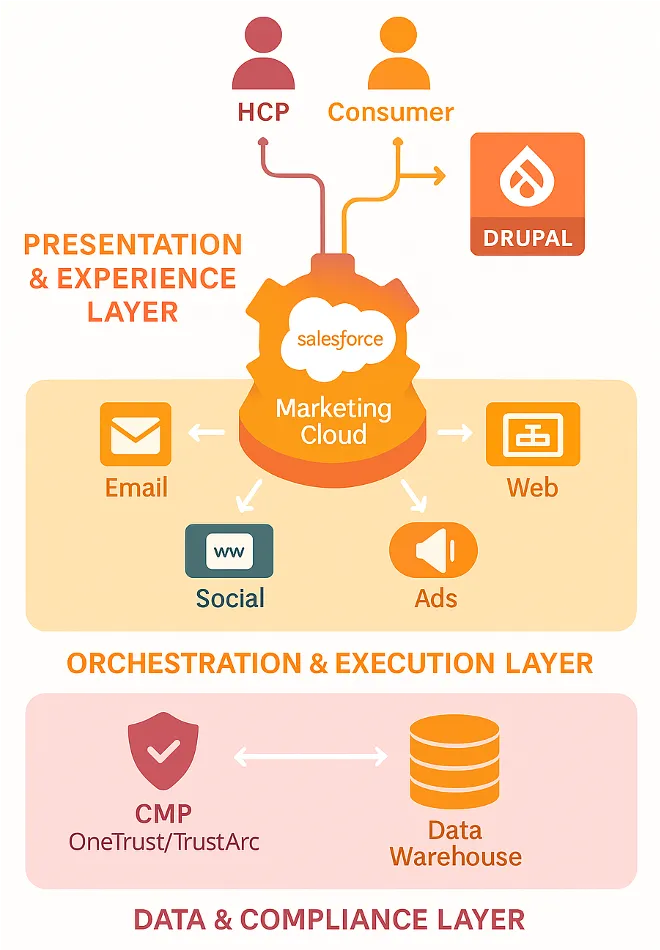
We designed and implemented an integrated, multi-channel MarTech stack to serve as the central nervous system for all marketing operations.
- Salesforce Marketing Cloud (SFMC): Chosen as the central hub for journey orchestration and omnichannel automation (email, SMS, social, advertising).
- Drupal-based Web CMS: Selected for its flexibility and scalability to power brand-specific websites, allowing for global governance with local content delivery.
- Consent Management Platforms (CMPs): OneTrust and TrustArc were integrated at the data layer to capture, store, and manage user consent across all digital properties, ensuring compliance by design.
- Integration Layer: Mulesoft and custom APIs were used to create bidirectional data flow between SFMC, the CMS, CMPs, and legacy CRM systems.
4.2. Pillar 2: Fostering Cross-Functional Orchestration
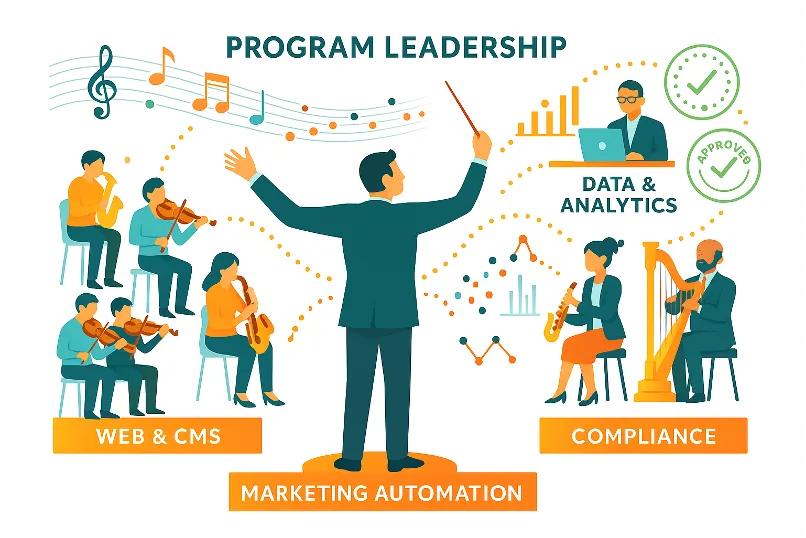
Technology is only as effective as the people and processes behind it. We established a new operating model that broke down traditional silos.
- Integrated Teams: We created dedicated pods combining web developers, SFMC specialists, SEO/content experts, data analysts, and compliance officers. This ensured every campaign was built with technical feasibility, analytical insight, and regulatory compliance from the outset.
- 360° Customer View: By integrating backend systems, we unified previously siloed data, enabling sophisticated segmentation and targeting based on a complete picture of HCP and consumer interactions.
4.3. Pillar 3: Executing Global Transformation with Local Precision
A "one-size-fits-all" approach is destined to fail in global pharma. Our rollout strategy balanced global efficiency with local relevance.
- Global Governance: A central core team defined the global standards, technology blueprint, and compliance protocols.
- Local Empowerment: Local market teams were trained and empowered to use the new global system to execute campaigns tailored to their region's language, culture, and specific regulatory nuances.
- Phased Rollout: The transformation was executed in phases across the 10 global brands and 14 markets, allowing for learning and optimization.
5. Results & Measurable Impact
The program delivered significant, quantifiable value across operational, compliance, and commercial dimensions.
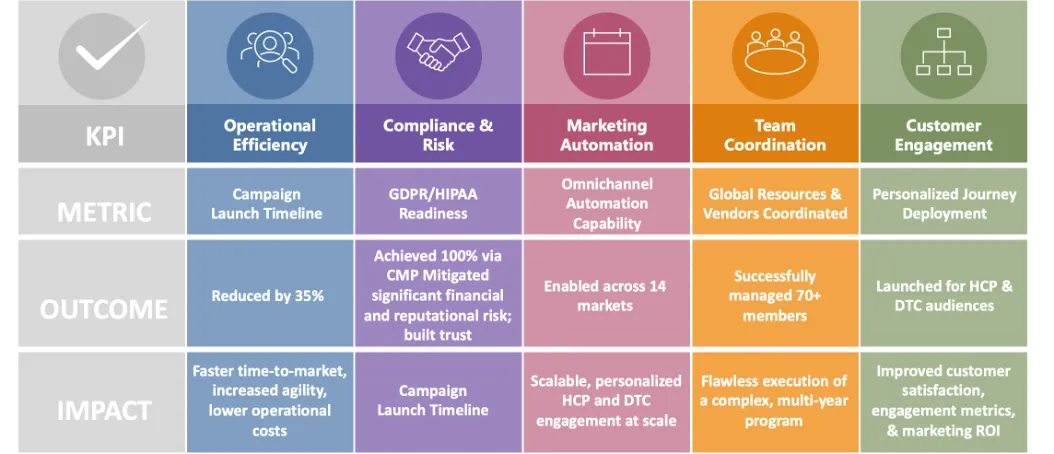
The transformation not only modernized the MarTech stack but also enabled the client to engage customers with greater speed, accuracy, and compliance, strengthening their competitive position in an increasingly digital-first pharma market.
6. Analysis: Key Success Factors for Sustainable Transformation
The technology deployment was a success, but these underlying factors were the true drivers of value:
- Strategic Alignment: Unwavering alignment between global HQ (setting the vision and budget) and local market teams (providing on-the-ground insights and adoption) was non-negotiable.
- MarTech as a Business Enabler: The program was championed by Marketing and seen as a strategic business investment to drive growth, not just an IT project to implement new software.
- Process Before Technology: We spent significant time mapping and redesigning processes before configuring the technology, ensuring the tools solved real operational problems.
- Change Management & Training: A continuous investment in training and support ensured that teams across all markets felt confident and empowered to use the new platform to its full potential.
7. Conclusion & Next Steps: The Journey to Continuous Maturity
Digital transformation is not a one-time project but a continuous journey towards greater maturity. For this global pharma leader, establishing the integrated MarTech foundation was the critical first step. The platform now generates a rich stream of unified data, creating new opportunities for the next phase of maturity: Advanced Analytics and AI-Driven Engagement.
The future roadmap includes leveraging this data to build predictive models for customer behavior, deploying AI for next-best-action recommendations, and further personalizing content at an individual level—all within the secure and compliant framework that has been established. This case study provides a replicable framework for any pharmaceutical company seeking to modernize its engagement model, turn compliance from a constraint into an advantage, and thrive in the digital future.
8. Appendix: Technologies Deployed
- Marketing Automation: Salesforce Marketing Cloud (SFMC)
- Web Content Management: Drupal
- Consent Management: OneTrust, TrustArc
- Web Analytics: Google Analytics, Adobe Analytics
- Integration & API Management: Mulesoft
- CRM: Salesforce Sales Cloud
Case study: Global Pharma · 10+ brands, 14 markets · Integrated MarTech maturity DOWNLOAD PDF VERSION