
The Future-Proof Operations

📑 Table of Contents
- 1. Executive Summary
- 2. Introduction: The CTV Revolution and the Operational Imperative
- 3. The Pre-Transformation Landscape: Fragmentation and Friction
- 4. The Strategic Vision: A Three-Pillar Transformation Framework
- 5. Measuring Success: Quantitative and Qualitative Impact
- 6. Analysis: Key Success Factors and Lessons for the Industry
- 7. Conclusion: Building the Operational Backbone for a $30B Future
- 8. Appendix: Framework for Replication
1. Executive Summary
The Connected TV (CTV) advertising market is exploding, projected to reach tens of billions in revenue by 2030. For a global consumer electronics leader, this growth presented both an immense opportunity and an existential operational challenge. An acquisition had created a siloed, inefficient, and high-cost ad operations unit in Canada, incapable of supporting the company's audacious goal of scaling its Smart TV business 30x.
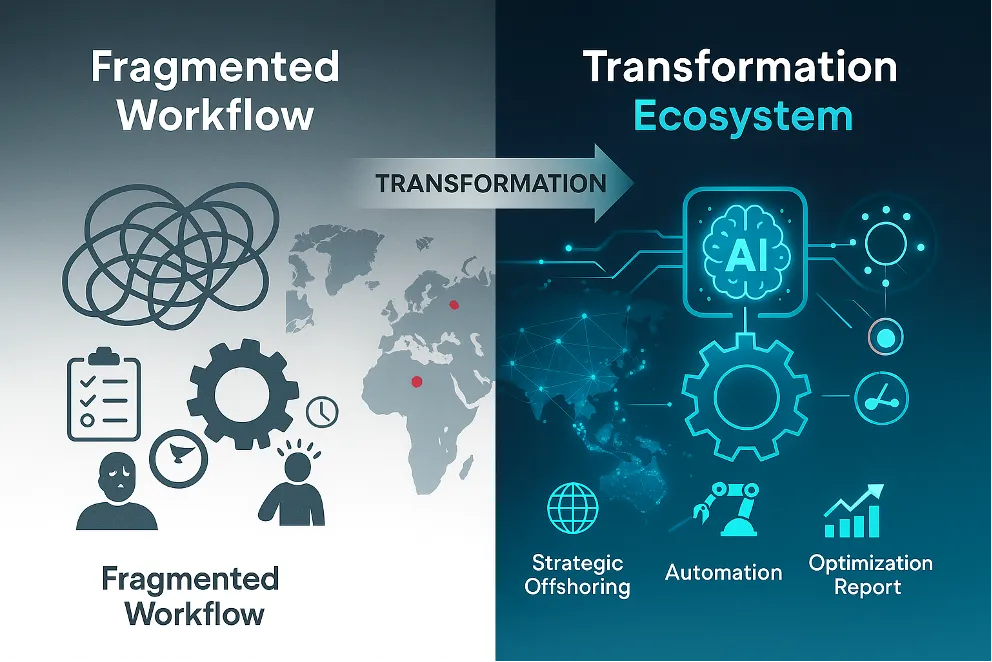
This white paper details a comprehensive transformation journey that moved beyond simple cost-cutting to a fundamental strategic reinvention. The initiative rested on three core pillars: (1) a meticulously planned geographic transition of 75 FTEs from Canada to India, (2) the implementation of a robust automation foundation for key operational workflows, and (3) the groundbreaking integration of a Generative AI layer for advanced campaign intelligence and predictive insights.
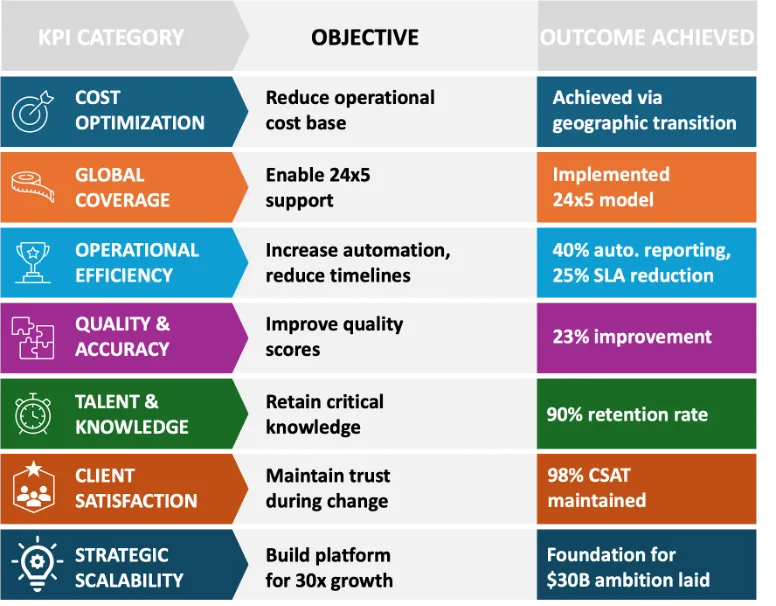
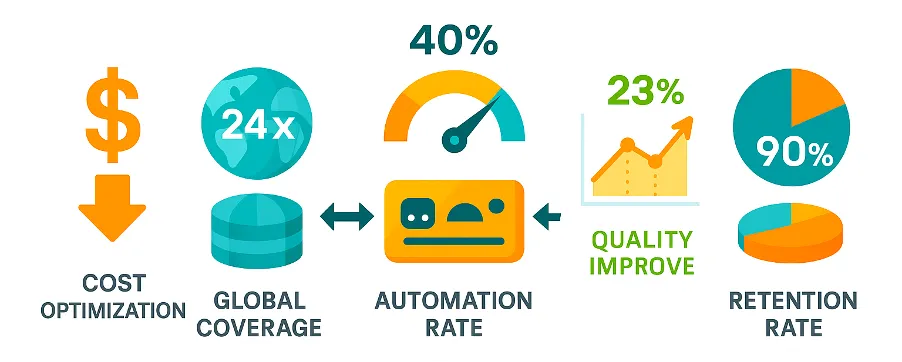
The results were transformative: significant cost optimization, the establishment of a 24x5 global support model, a 40% automation rate in manual reporting, a 25% reduction in SLA timelines, and the creation of a scalable backbone for a $30B revenue ambition. This paper provides a blueprint for any organization looking to future-proof its operations through a holistic combination of people, process, technology, and cutting-edge AI.
2. Introduction: The CTV Revolution and the Operational Imperative
Connected TV has dismantled traditional advertising paradigms, offering unprecedented targeting, measurability, and engagement. For hardware manufacturers like Samsung, it transforms the television from a passive device into a dynamic, data-driven advertising platform. However, this shift places immense pressure on ad operations—the engine that launches, manages, and optimizes campaigns. Legacy structures, built for linear TV, are too slow, too expensive, and too opaque to compete. The ability to scale operations efficiently is no longer a competitive advantage; it is a strategic necessity for survival and growth in the CTV arena.
3. The Pre-Transformation Landscape: Fragmentation and Friction
The client's entry into the market via acquisition is a common growth strategy, but it often bequeaths a legacy of operational debt.
3.1. The Acquisition Hangover: Inheriting Silos
The acquired Canadian ad-tech company operated as an independent entity, creating a "team within a team" dynamic. This led to:
- Operational Fragmentation: Lack of integration with the parent brand's processes and systems.
- Inconsistent Standards: No unified framework for quality, accountability, or performance measurement.
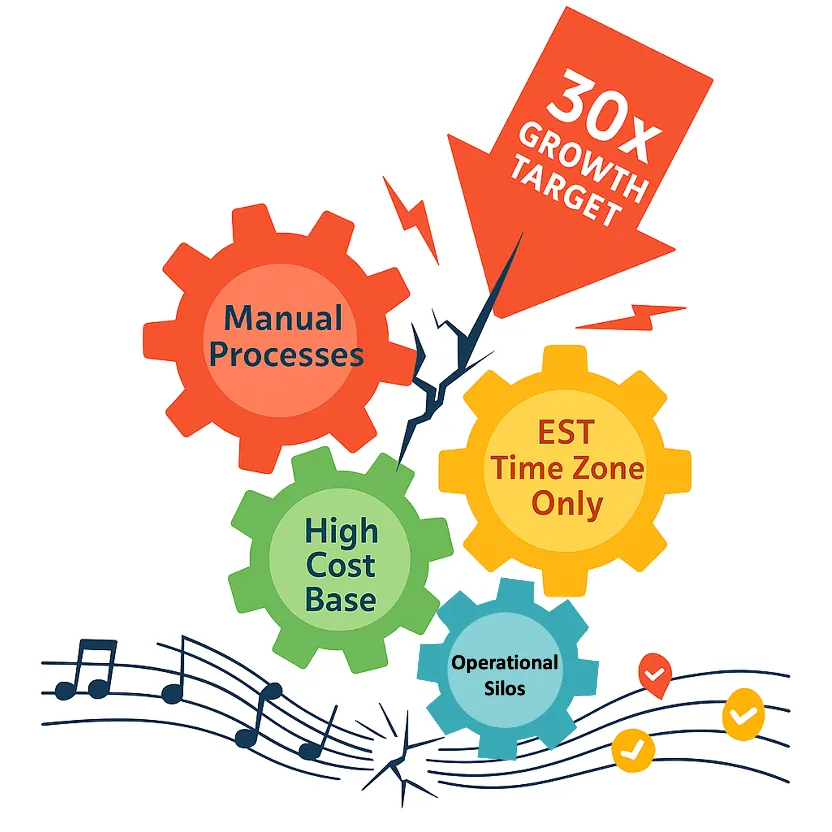
3.2. The Scaling Paradox: Ambition vs. Operational Reality
With a goal to scale 30x by 2030, the existing model was a critical bottleneck:
- High-Cost Center: A 75-FTE team in a high-wage geography made scaling cost-prohibitive.
- Limited Global Coverage: Support confined to EST time zones hampered the ability to serve a global advertiser base.
- Manual Inefficiency: Repetitive, manual processes for QA and reporting were prone to error and unable to handle increased volume.
- Scalability Risk: The disjointed model threatened the entire $30B Smart TV revenue ambition.
4. The Strategic Vision: A Three-Pillar Transformation Framework
The solution was not a simple lift-and-shift offshoring exercise. It was a holistic transformation designed to build a future-ready operation, structured on three interdependent pillars:
- Pillar 1: The Seamless Transition (People & Process)
- Pillar 2: The Automation Foundation (Technology & Process)
- Pillar 3: The GenAI Intelligence Layer (Technology & Intelligence)
4.1 Pillar 1: The Seamless Transition -- Mastering the People and Process Equation
The geographic migration of 75 roles was the most sensitive and critical component. Its success was governed by meticulous planning and human-centric change management.
- Due Diligence & Scope Definition: A comprehensive audit was conducted to map every process, knowledge domain, and dependency.
- Cross-Functional "Command Center": A dedicated team with representatives from HR, Legal, Operations, Subject Matter Experts (SMEs), and Six Sigma experts was formed to govern the transition.
- RACI Framework: A Clear Responsibility Assignment Matrix defined ownership for every task, eliminating ambiguity.
- Transparent Communication & Morale Management: Continuous updates, training programs for new hires, and feedback loops ensured employee engagement and minimized knowledge loss.

4.2 Pillar 2: The Automation Foundation -- Building Efficiency at Scale
Before adding intelligence, the foundation of core processes had to be streamlined and automated.
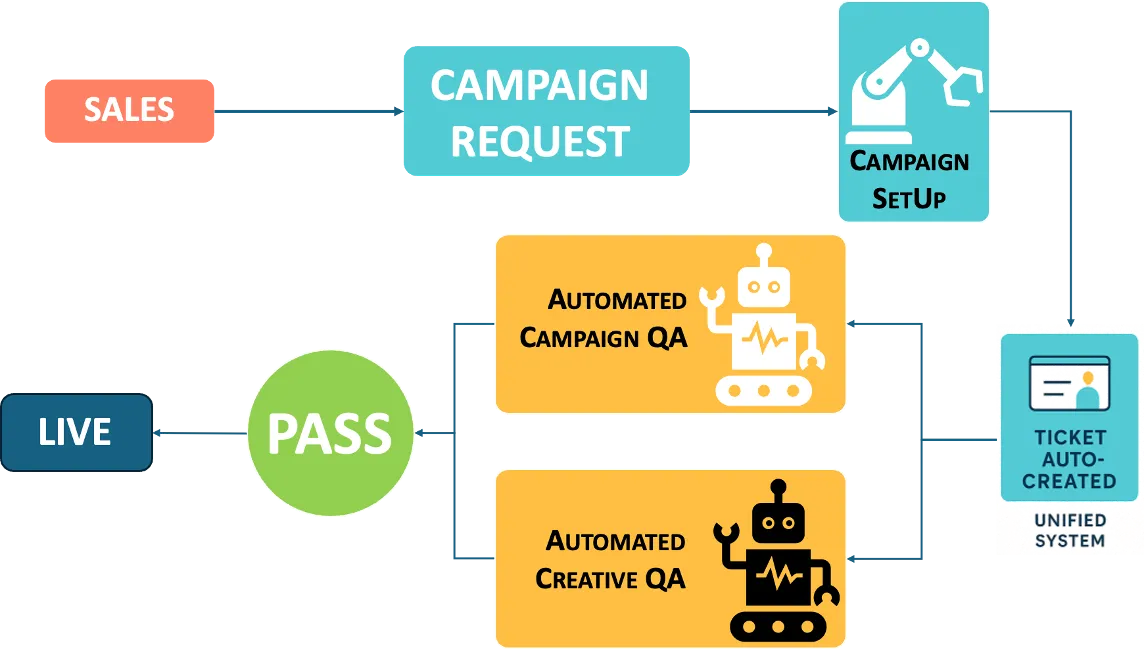
- Campaign QA Automation: Developed tools to automatically validate campaign setup data (budgets, targeting, flight dates) across multiple platforms (DSPs, Ad Servers), drastically reducing human error.
- Creative QA Automation: Automated the validation of creative assets (file format, size, click-through URLs) and generated automated screenshots for client approval.
- Unified Ticketing & Real-Time Dashboards: Implemented a central system to manage all campaign-related tasks, providing live visibility into status, bottlenecks, and team capacity. This replaced scattered emails and spreadsheets.
4.3 Pillar 3: The GenAI Intelligence Layer -- From Data to Foresight
This pillar moved the operation from reactive management to proactive optimization and strategic insight.
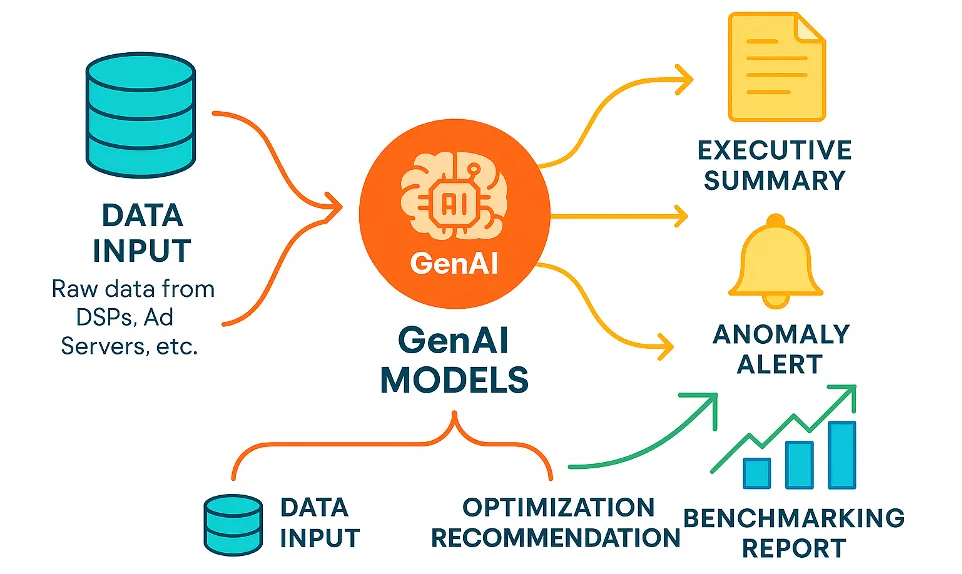
- Automated Executive Reporting: GenAI models were trained to ingest raw data from various sources and generate polished, narrative-driven summaries for leadership, saving countless manual hours.
- Natural Language Summaries: The system translated complex Excel-based reports into easy-to-digest bulleted briefs for stakeholders.
- Anomaly Detection & Root-Cause Analysis: AI algorithms continuously monitored campaign performance, automatically flagging underperformance and suggesting potential causes (e.g., "CTR dropped 15% due to audience saturation").
- Benchmarking Engine: Campaigns were automatically compared against category benchmarks and historical performance to contextualize results.
- Predictive Insights: The system recommended optimization strategies based on historical trends and predictive modeling (e.g., "Suggest reallocating 20% of budget from Audience A to Audience B based on predicted conversion lift").
5. Measuring Success: Quantitative and Qualitative Impact
The transformation delivered value across financial, operational, and strategic dimensions.
6. Analysis: Key Success Factors and Lessons for the Industry
- Holistic Vision: Success came from addressing People, Process, and Technology simultaneously, not in isolation.
- GenAI as a Strategic Layer: AI was not a gimmick; it was integrated as a core intelligence layer that augmented human decision-making.
- Change Management is Non-Negotiable: The 90% retention rate proves that treating people with respect and transparency is the key to a successful transition.
- Build for the Future: The project was framed around a long-term (2030) goal, ensuring every decision supported scalability and future growth, not just immediate cost savings.
7. Conclusion: Building the Operational Backbone for a $30B Future
This transformation was more than a geographic shift; it was a strategic reinvention of the ad operations function. By aligning a seamless people transition with a bedrock of automation and a ceiling of AI-powered intelligence, the company did not just solve a cost problem. It built a scalable, efficient, and intelligent operational backbone capable of powering its dominant ambition in the CTV market. This case study provides a replicable framework for any enterprise looking to turn its operations from a cost center into a competitive weapon.
8. Appendix: Framework for Replication
Phase 1: Assess & Plan
- Conduct a current-state process audit.
- Define future-state operational model and KPIs.
- Secure executive sponsorship and form a cross-functional team.
Phase 2: Execute Transition
- Develop a detailed RACI and project plan.
- Implement robust knowledge transfer and training programs.
- Prioritize communication and change management.
Phase 3: Automate Foundations
- Identify and prioritize processes for automation (QA, reporting).
- Select and implement tooling for workflow unification.
Phase 4: Integrate Intelligence
- Audit data sources and availability.
- Partner with AI/ML teams to develop and train models for insights.
- Pilot with a single brand or campaign type before scaling.
Case study: Global consumer electronics leader · 75 FTEs transition, 30x scalability DOWNLOAD PDF VERSION