
The Generative AI Revolution in Ad Operations
📑 Table of Contents
- 1. Executive Summary
- 2. Introduction: The AdOps Bottleneck in a Hyper-Scale Digital World
- 3. The Status Quo: Diagnosing the Pains of Modern Ad Operations
- 4. The Breakthrough: A Framework for GenAI Integration
- 5. The Core Capabilities: GenAI in Action Today
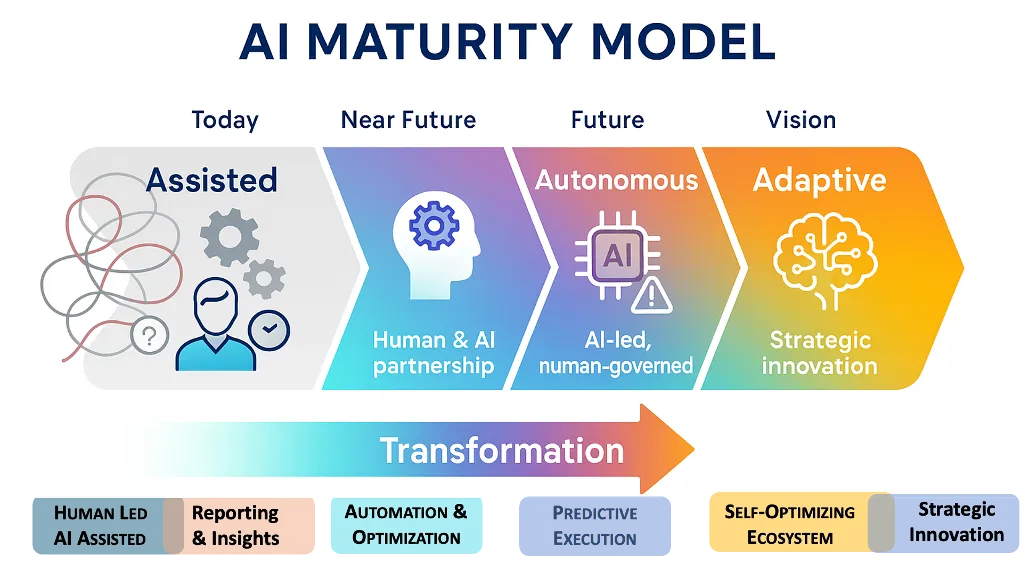
- 6. The Future Outlook: The Roadmap to Autonomous Ad Operations
- 7. The Technology: Advanced Prompting and Architecture
- 8. The Results: Measurable Impact on Efficiency and Effectiveness
- 9. Implementation Guide: Getting Started with GenAI in Your AdOps
- 10. Conclusion: The Future AdOps Team — Strategists Augmented by AI
- 11. Appendix: Glossary of Key GenAI Terms
1. Executive Summary
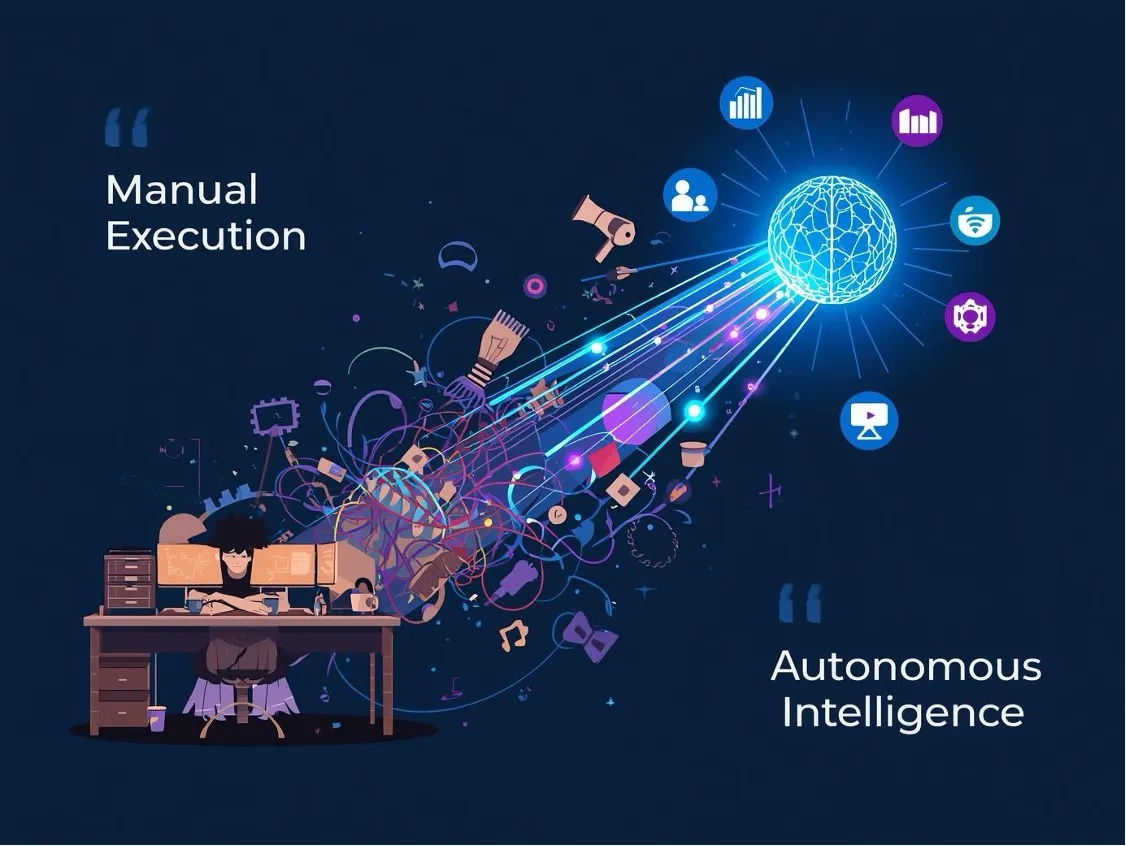
The digital advertising landscape is defined by scale, complexity, and an unrelenting demand for ROI. At the heart of this ecosystem, Ad Operations (AdOps) teams are buckling under the weight of manual processes, data overload, and the impossible task of deriving real-time insights from sprawling campaigns. This white paper presents a paradigm shift: the integration of Generative AI (GenAI) as a core component of the AdOps tech stack.
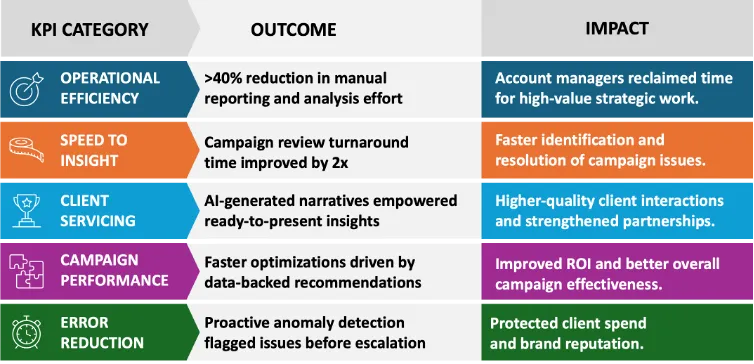
Through a detailed case study of a global leader, we demonstrate how GenAI moves AdOps from a cost center of manual execution to a value center of automated intelligence. The implementation of capabilities like automated reporting, anomaly detection, and predictive optimization yielded over 40% efficiency gains and 2x faster insights. Furthermore, this paper expands the view into a comprehensive future roadmap, outlining how GenAI will evolve to manage end-to-end campaign automation, hyper-personalized creative generation, and predictive cross-channel orchestration. The conclusion is clear: GenAI is not just a tool for incremental improvement; it is the foundational technology that will define the next era of advertising efficiency and effectiveness. The future-winning AdOps team will be one where humans are empowered by AI co-pilots to focus on strategy, creativity, and client partnership.
2. Introduction: The AdOps Bottleneck in a Hyper-Scale Digital World
Ad Operations is the critical engine room of digital advertising. Teams are responsible for launching, trafficking, monitoring, and optimizing campaigns across a fragmented ecosystem of DSPs, ad servers, and social platforms. However, this engine is sputtering. The volume of data has exploded, but the tools to process it have not kept pace. Account Managers spend most of their time on manual, repetitive tasks—synthesizing reports, hunting for anomalies, and formatting presentations—leaving little room for the strategic analysis that drives true campaign growth. This operational drag is the single biggest bottleneck to scaling digital advertising efforts profitably.
3. The Status Quo: Diagnosing the Pains of Modern Ad Operations
The challenges faced by our client are ubiquitous across the industry.
3.1. The Data Deluge and the Insight Drought
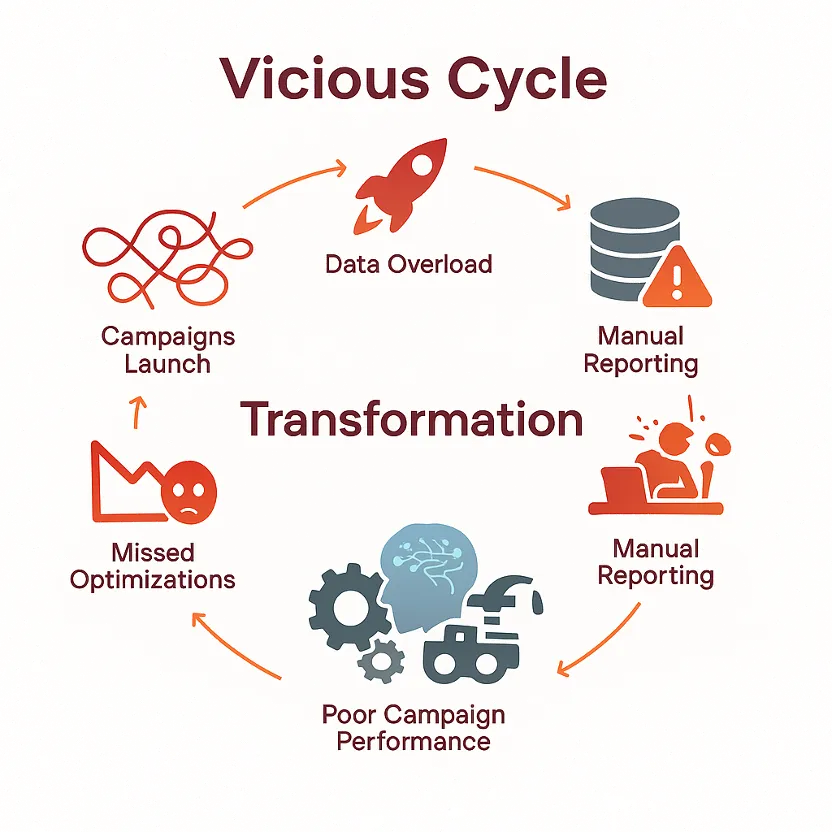
AdOps professionals are drowning in data but starving for insights. Raw data exports from multiple platforms are dense, unwieldy, and time-consuming to interpret manually. This creates a lag between data collection and actionable decision-making, causing missed optimization opportunities.
3.2. The Strategic Cost of Manual Labor
The relentless grind of manual reporting and campaign monitoring comes at a high cost:
- Opportunity Cost: Skilled account managers are diverted from high-value strategic advisory and client servicing.
- Error Cost: Manual processes are prone to oversight, leading to delayed responses to underperforming campaigns.
- Scale Cost: The model does not scale. Handling twice the campaign volume requires twice the headcount, a linear and costly approach.
4. The Breakthrough: A Framework for GenAI Integration
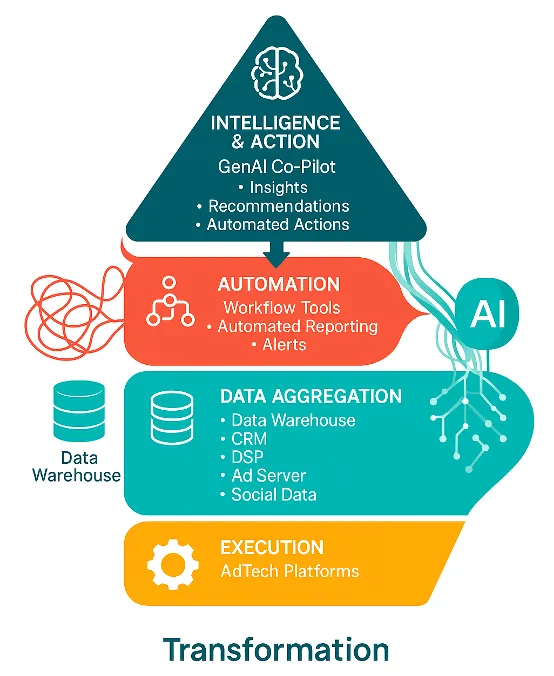
The solution was to integrate a GenAI layer that sits atop the existing AdTech stack, acting as an intelligent co-pilot for the entire team.
5. The Core Capabilities: GenAI in Action Today
The implemented GenAI solution focused on solving the most pressing pain points with tangible capabilities.
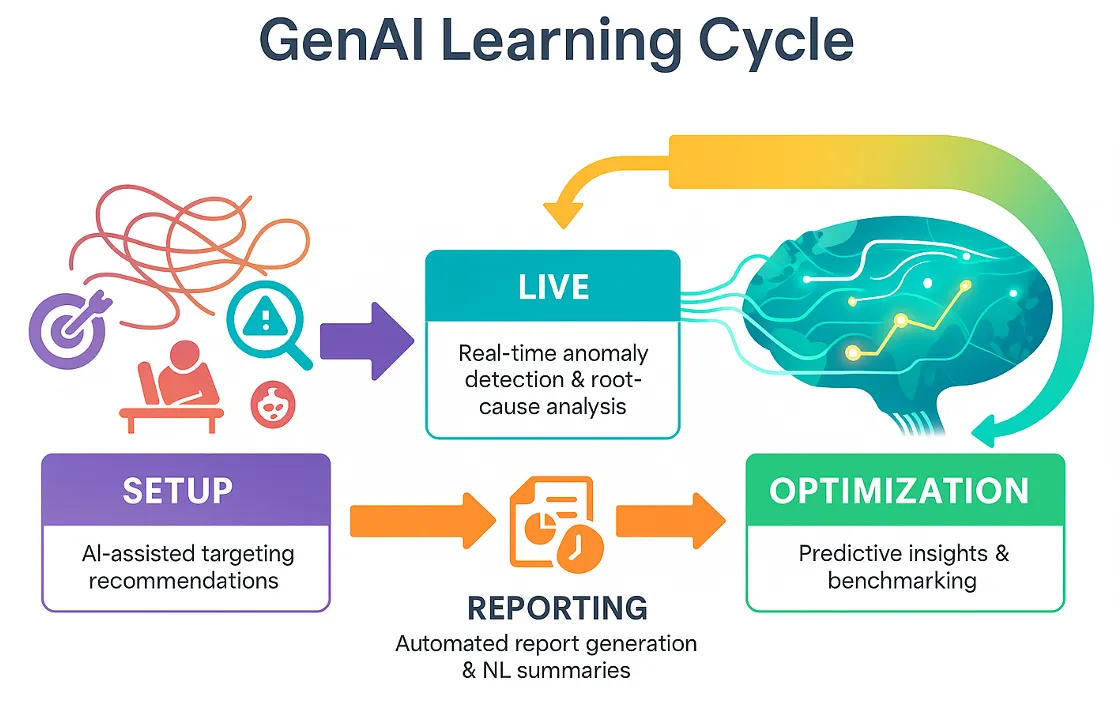
5.1. Automated Reporting & Natural Language Summarization
What it is: GenAI models are trained to ingest raw CSV/Excel exports from multiple platforms and generate polished, narrative-driven summaries.
Impact: This saved countless hours of manual copy-pasting and chart formatting, freeing up account managers to analyze the data.
5.2. Anomaly Detection & Root-Cause Analysis
What it is: AI algorithms continuously monitor KPIs (CTR, CPC, Conv. Rate). Upon detecting a significant drop or spike, the system doesn't just flag it—it suggests probable causes (e.g., "CTR dropped 15% due to audience fatigue on Creative B").
Impact: This moved the team from reactive firefighting to proactive campaign management.
5.3. Benchmarking & Optimization Insights
What it is: The system compares campaign performance against historical data and category benchmarks. It then provides data-backed recommendations (e.g., "Reallocate 20% of budget from Placement X to Placement Y for a predicted 10% lift in conversions").
Impact: This empowered account managers with strategic, actionable insights they could immediately execute or discuss with clients.
6. The Future Outlook: The Roadmap to Autonomous Ad Operations
The current capabilities are just the beginning. The future of GenAI in AdOps points toward increasing levels of autonomy.
6.1. Phase 1: End-to-End Campaign Automation
- Campaign Setup Automation: GenAI generates full campaign briefs, targeting parameters, and creative mandates based on client objectives.
- Dynamic Budget Optimization: AI runs real-time simulations to automatically reallocate spend across channels and audiences to maximize ROI.
6.2. Phase 2: Creative & Audience Intelligence at Scale
- Hyper-Personalized Creative Generation: GenAI generates thousands of ad copy and visual variations tailored to micro-audiences.
- Predictive Audience Targeting: AI models identify net-new high-value audience segments before a campaign even launches.
6.3. Phase 3: Predictive Orchestration & Strategic Advisory
- Cross-Channel Orchestration: GenAI ensures a unified customer journey by dynamically sequencing messaging across search, social, and programmatic.
- Strategic Storytelling & Simulation: AI generates entire quarterly business reviews and runs "what-if" scenarios for strategic planning.
7. The Technology: Advanced Prompting and Architecture
The effectiveness of GenAI hinges on sophisticated engineering beyond simple queries. The solution utilized:
- Retrieval-Augmented Generation (RAG): To pull in the latest campaign data and KPIs for contextually accurate responses.
- Chain-of-Thought (CoT) Prompting: To force the AI to reason step-by-step, improving the logical depth of its analysis.
- Persona-Based Prompts: To tailor outputs, e.g., "Act as a senior digital strategist and explain this performance dip to a CMO."
8. The Results: Measurable Impact on Efficiency and Effectiveness
The implementation delivered significant and immediate value.
9. Implementation Guide: Getting Started with GenAI in Your AdOps
- Identify High-Impact Use Cases: Start with a painful, repetitive task like report generation or anomaly detection.
- Audit and Prepare Your Data: Ensure you have clean, accessible data from your key platforms (DSPs, Ad Servers).
- Select the Right Technology Partner: Evaluate platforms based on their ability to integrate with your stack and their use of advanced techniques like RAG.
- Pilot with a Small Team: Run a controlled pilot with a handful of power users to refine the tool and demonstrate ROI.
- Scale with Training and Change Management: Roll out the tool broadly with extensive training, positioning it as a co-pilot that augments, not replaces, human expertise.
10. Conclusion: The Future AdOps Team — Strategists Augmented by AI
The integration of Generative AI marks the end of AdOps as a manual, execution-focused function. It heralds the beginning of a new era where AdOps professionals are liberated from data wrangling and empowered to become strategic advisors, creative thinkers, and indispensable partners to their clients. The future team will be comprised of AI-augmented strategists who oversee a largely autonomous advertising engine, focusing their efforts on business outcomes, creative direction, and deepening client relationships. The organizations that embrace this shift will not only achieve unparalleled efficiency but will also unlock new levels of strategic growth and competitive advantage.
11. Appendix: Glossary of Key GenAI Terms
- Generative AI (GenAI): A type of AI that can create new content and ideas, including conversations, stories, images, videos, and music.
- Large Language Model (LLM): A type of AI model that uses deep learning techniques and massively large data sets to understand, summarize, generate, and predict new content.
- Prompt Engineering: The practice of designing and refining input prompts to get the desired output from an LLM.
- Retrieval-Augmented Generation (RAG): A technique that improves the accuracy and quality of GenAI responses by retrieving facts from an external knowledge base.
- Chain-of-Thought (CoT): A prompting technique that encourages the LLM to explain its reasoning process step-by-step.
Case study: Global advertising leader · 40% efficiency gains, 2x faster insights DOWNLOAD PDF VERSION