
The Master Service Provider Transition

📑 Table of Contents
- 1. Executive Summary
- 2. Introduction: The Third-Party Scaling Paradox in AdTech
- 3. The Catalyst for Change: Diagnosing a Fragile Operating Model
- 4. The Strategic Pivot: Selecting a Master Service Provider (MSP)
- 5. The Transformation Framework: A Three-Pillar Approach
- 6. Proactive Risk Mitigation: From Attrition to Institutional Amnesia
- 7. Results & Impact: Quantifying the Value of a Strategic Partnership
- 8. Analysis: Key Success Factors and Lessons Learned
- 9. Conclusion: The MSP as a Strategic Growth Partner, Not a Vendor
- 10. Appendix: Transition Checklist for Large-Scale MSP Migrations
1. Executive Summary
The rapid evolution of the AdTech landscape demands operational models that are not only efficient but also scalable, governed, and resilient. For a global Internet Giant, its reliance on a third-party staffing provider for its flagship Demand-Side Platform (DSP) operations had become a critical business risk. Governance gaps, talent retention issues, and an inability to scale threatened the product's market position.
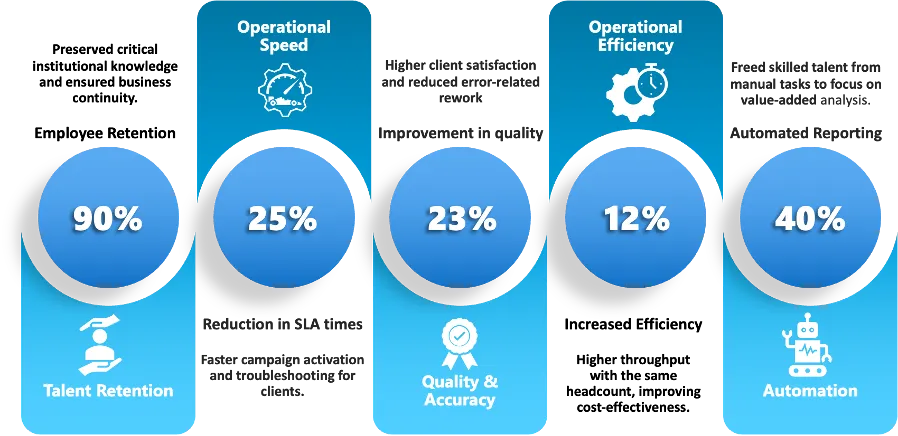
This white paper details a successful large-scale transition of 85 FTEs from a staffing model to a strategic Master Service Provider (MSP) partnership. The transformation was executed through a holistic framework addressing People, Process, and Technology, underpinned by meticulous change management. The results were transformative: 90% employee retention, a 25% reduction in SLA times, a 23% improvement in quality, and a 12% increase in operational efficiency within the first quarter. This case study provides a replicable blueprint for any organization seeking to mitigate third-party risk, instill operational excellence, and build a future-ready foundation for growth through a strategic MSP partnership.
2. Introduction: The Third-Party Scaling Paradox in AdTech
Technology giants often leverage third-party staffing providers to quickly scale operations for new products like Demand-Side Platforms (DSPs). This model offers flexibility but often at the cost of long-term stability. While effective for initial launch phases, the staffing model typically lacks:
- Strategic Governance: Clear accountability and performance management.
- Talent Development: Career pathways and investment in upskilling.
- Operational Resilience: Standardized processes and continuous improvement mechanisms.
This creates a paradox: the very model used to scale becomes the primary obstacle to future growth. This was the challenge faced by our client, a leading Internet Giant.
3. The Catalyst for Change: Diagnosing a Fragile Operating Model
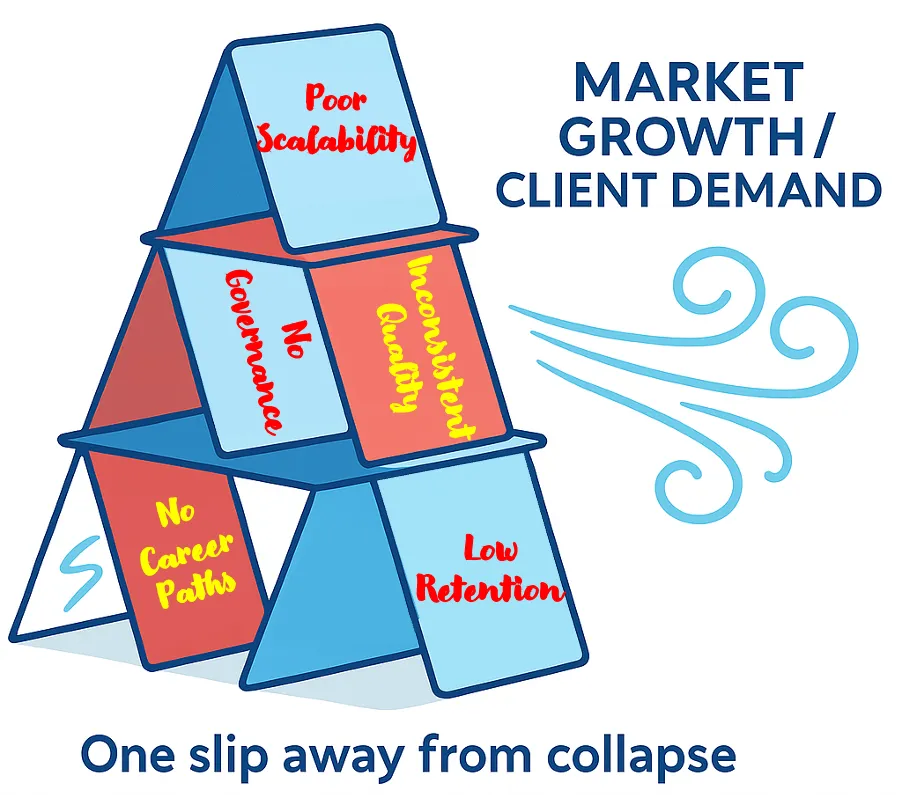
The decision to transition was driven by multiple interconnected vulnerabilities inherent in the staffing provider setup.
The Limitations of the Staffing Provider Model:
- Governance Gaps: Lack of a single point of accountability and limited performance oversight.
- Scalability Constraints: Inability to efficiently expand or contract operations in response to market demands.
- Talent Stagnation: High performers had no defined career progression, leading to morale issues and attrition.
- Process Inconsistency: Ad-hoc workflows and a lack of standardization led to quality fluctuations.
4. The Strategic Pivot: Selecting a Master Service Provider (MSP)
The client made a strategic decision to move from a transactional staffing relationship to a strategic partnership with a Master Service Provider (MSP). An MSP differs fundamentally from a staffing provider:
- Accountability: The MSP assumes full responsibility for delivery, outcomes, and talent management.
- Governance: Provides a structured framework with defined SLAs, KPIs, and regular performance reviews.
- Value Addition: Focuses on continuous improvement, automation, and strategic innovation, not just filling seats.
5. The Transformation Framework: A Three-Pillar Approach
The transition was governed by a framework designed to manage complexity and ensure holistic success.
- Pillar 1: The Foundation - Due Diligence & Planning
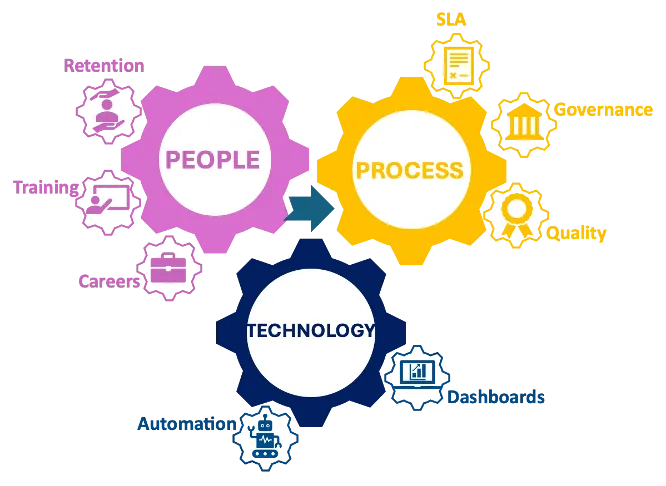
- Pillar 2: The Execution Engine - People, Process, Technology
- Pillar 3: The Human Core - Change Management & Communication
5.1 Pillar 1: The Foundation — Meticulous Due Diligence & Planning
The success of any large-scale transition is determined before execution begins.
- Scope Definition: A meticulous activity-based categorization removed all ambiguity about what was in-scope and out-of-scope.
5.1.1 The Cross-Functional "Transformation Command Center": A dedicated team was assembled, including:
- HR (for retention and hiring)
- Legal (for contracting)
- Operations (for delivery)
- DSP Subject Matter Experts (for knowledge)
- Lean Six Sigma Black Belts (for process improvement)
Stakeholder Alignment: A comprehensive map identified all sponsors, influencers, and impacted teams to tailor communication.
5.2 Pillar 2: The Execution Engine — Managing People, Process, and Technology
With a plan in place, execution focused on three interconnected levers.
5.2.1 The Talent Retention and Engagement Playbook
- Proactive Engagement: Leadership held one-on-one meetings with all 85 FTEs to build confidence and understand concerns.
- Retention Incentives: Structured retention bonuses were offered for key personnel.
- Career Pathway Design: New roles and levels were created within the MSP model to provide clear progression and development opportunities.
5.2.2 Process Optimization and Automation Road mapping
- Immediate Wins: Quick, high-impact process tweaks were identified and implemented to show early value.
- Long-Term Roadmap: A formal pipeline was created for automation (e.g., 40% of manual reporting was automated) and continuous improvement projects.
5.2.3 Instilling Robust Governance and Hierarchy
- Performance Dashboards: Real-time dashboards were established to track SLAs, quality, and efficiency metrics, providing transparency for all stakeholders.
- Formal Escalation Paths: A clear governance model defined decision rights and escalation procedures to resolve issues rapidly.
5.3 Pillar 3: The Human Core — Mastering Change Management
The biggest risk was cultural, not operational. Many contractors identified strongly with the client's brand.
5.3.1 Addressing the "Cultural Identity" Crisis: Communication was carefully crafted to celebrate their continued contribution to the product while welcoming them into a new organization with its own strengths and opportunities.
5.3.2 The Three-Tier Communication Strategy:
- I. Strategic: Why is this change happening? (Executive town halls)
- II. Tactical: What does it mean for me? (Team-level FAQs, direct manager meetings)
- III. Operational: How do I do my job now? (Training, updated SOPs, knowledge base access)
6. Proactive Risk Mitigation: From Attrition to Institutional Amnesia
Risks were anticipated and mitigated proactively:
- Short-Term Risk (Attrition): Addressed through engagement, bonuses, and leadership visibility.
- Long-Term Risk (Knowledge Loss): Mitigated through structured Knowledge Transfer (KT) frameworks, comprehensive documentation, and shadowing programs that paired existing experts with new hires.
7. Results & Impact: Quantifying the Value of a Strategic Partnership
The transition delivered measurable value across financial, operational, and qualitative dimensions within the first quarter.
8. Analysis: Key Success Factors and Lessons Learned
- Treat Transition as a Program, Not a Project: It requires dedicated, cross-functional leadership and a holistic framework.
- People are the Priority: A transition is a human event. Proactive talent management is the single most important factor for success.
- Governance is Non-Negotiable: Establishing clear accountability and performance metrics from day one is critical.
- Communicate, Then Communicate Again: Over-communication through multiple channels is essential to combat uncertainty and fear.
- Plan for the Long Term: The goal is not just to transition but to transform. Building a roadmap for continuous improvement ensures the new model delivers sustained value.
9. Conclusion: The MSP as a Strategic Growth Partner, Not a Vendor
This transition demonstrates that moving from a staffing provider to a Master Service Provider is not merely a vendor change. It is a strategic upgrade to the operating model. An MSP acts as a true partner, assuming accountability for outcomes, investing in talent, and driving innovation through process improvement and automation. For the Internet Giant, this partnership didn't just solve immediate operational challenges; it built a scalable, governed, and high-performing foundation capable of supporting its DSP's growth for years to come. For any organization reliant on critical third-party operations, this case provides a proven blueprint for making the same strategic leap.
10. Appendix: Transition Checklist for Large-Scale MSP Migrations
- Due Diligence: Conduct comprehensive scope definition and knowledge assessment.
- Team Assembly: Form a cross-functional transformation team.
- Stakeholder Mapping: Identify and map all key stakeholders and influencers.
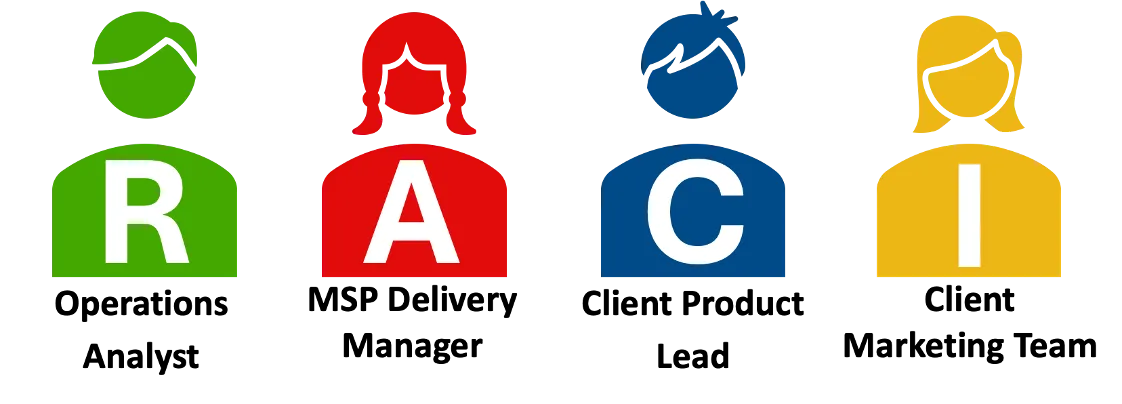
- RACI Development: Create a RACI matrix for all critical processes.
- Change Management Plan: Develop a detailed communication and training plan.
- Risk Mitigation Plan: Identify key risks (attrition, knowledge loss) and develop mitigation strategies.
- Day-1 Readiness: Ensure technology, access, and training are in place for a seamless cut-over.
- Governance Framework: Establish performance dashboards and regular review cadences.
- Continuous Improvement Roadmap: Develop a 6-12 month plan for automation and process enhancement.
Case study: Global Internet Giant · 85 FTE transition, 90% retention, 25% faster SLAs DOWNLOAD PDF VERSION