
The Operational Excellence Blueprint

📑 Table of Contents
- 1. Executive Summary
- 2. Introduction: The Managed Services Dilemma — Value vs. Volatility
- 3. The Pre-Transformation State: A Diagnosis of Chaos
- 4. The Strategic Framework: The Three Pillars of Operational Excellence
- 5. The Impact: Quantifying the Transformation
- 6. Analysis: The Underlying Principles of Operational Excellence
- 7. Conclusion: The Journey from Cost Center to Value Engine
- 8. Appendix: Starter Kit for Operational Excellence
1. Executive Summary
In the competitive world of managed services, delivery excellence is the only true differentiator. Yet, many organizations remain trapped in a cycle of reactive firefighting, unpredictable resourcing, and eroding client trust. This white paper details a successful transformation of a global managed services provider from a state of operational chaos into a process-driven, efficient delivery engine.
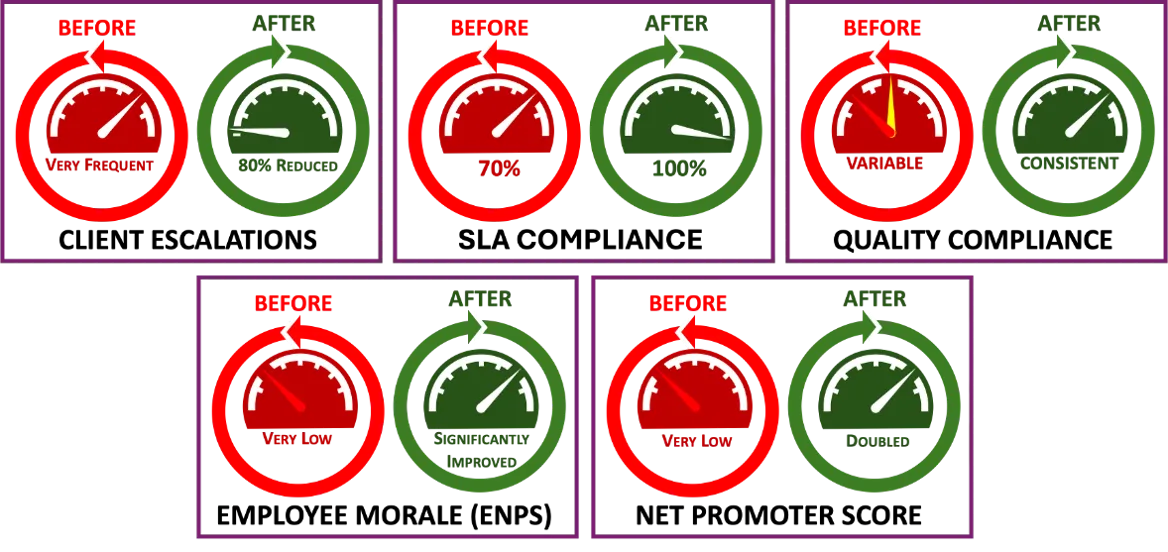
Faced with unstructured workflows, inconsistent workforce planning, and reactive client communication, the organization implemented a rigorous three-pillar framework focused on: (1) Predictive Workforce Planning, (2) Process Standardization, and (3) Proactive Client Governance. The results were dramatic: an 80% reduction in client escalations, a 30% improvement in SLA compliance, a doubled Net Promoter Score (NPS), and the achievement of 99% quality compliance. This paper provides a proven blueprint for any service delivery leader seeking to eliminate chaos, build client trust, and create a scalable, predictable, and high-performing operational model.
2. Introduction: The Managed Services Dilemma — Value vs. Volatility
Managed Service Providers (MSPs) promise clients predictability, expertise, and operational efficiency. However, internally, many MSPs struggle with the very volatility they are hired to mitigate. Unplanned attrition, last-minute leave, undocumented processes, and reactive communication create a fundamental misalignment between promise and delivery. This internal chaos translates directly into client-facing issues: missed SLAs, unexpected escalations, and ultimately, a loss of trust. The journey to operational excellence is therefore not just about internal efficiency; it is about aligning internal operations to deliver on the core value proposition promised to clients.
3. The Pre-Transformation State: A Diagnosis of Chaos
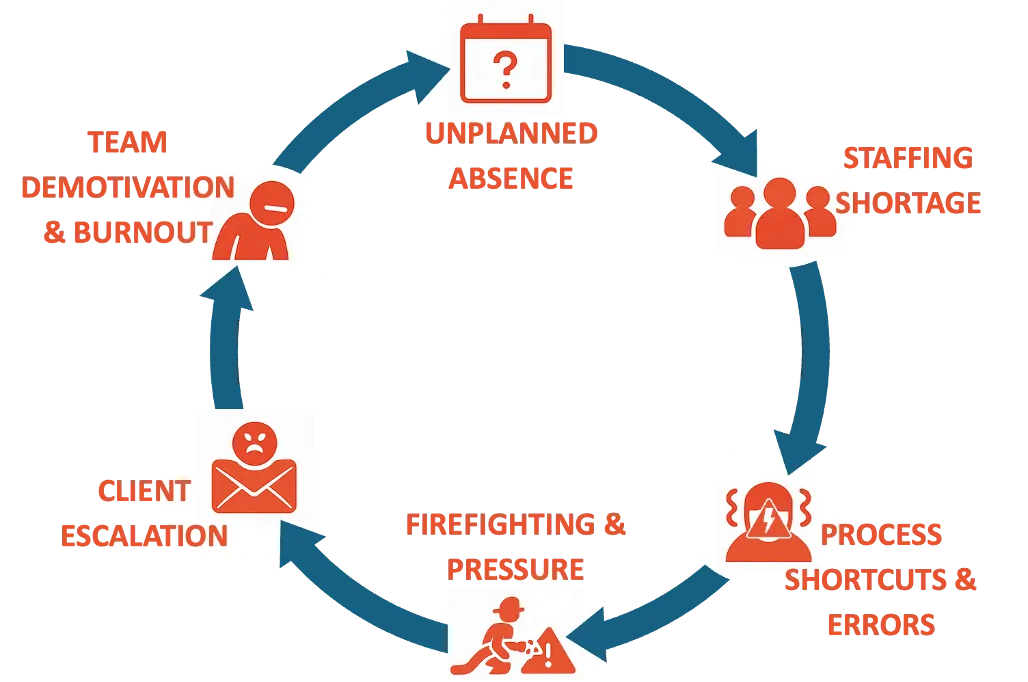
The client's operations exhibited classic symptoms of a poorly managed service delivery unit.
3.1. Symptom 1: The Process Abyss
- Workflows existed only in the minds of veteran employees, leading to inconsistent execution.
- A reliance on verbal communication and "tribal knowledge" resulted in misalignment and errors.
- The absence of quality control checkpoints meant errors were discovered by the client, not the team.
3.2. Symptom 2: The Resourcing Black Hole
- Staffing was reactive. Unplanned absences created critical shortages, forcing remaining team members into burnout mode.
- There was no visibility into future capacity, making it impossible to plan for project work or absorb new client demands.
3.3. Symptom 3: The Trust Deficit
- Communication with clients was reactive and often occurred only after a problem had escalated.
- The lack of a clear escalation matrix meant clients never knew who to contact for what issue, leading to frustration.
4. The Strategic Framework: The Three Pillars of Operational Excellence
The transformation was engineered around three core, interdependent pillars designed to break the cycle of chaos.
- Pillar 1: Predictive Workforce Planning (The Foundation of Stability)
- Pillar 2: Process Standardization (The Architecture of Reliability)
- Pillar 3: Proactive Client Governance (The Engine of Trust)
4.1 Pillar 1: Predictive Workforce Planning — Engineering Stability
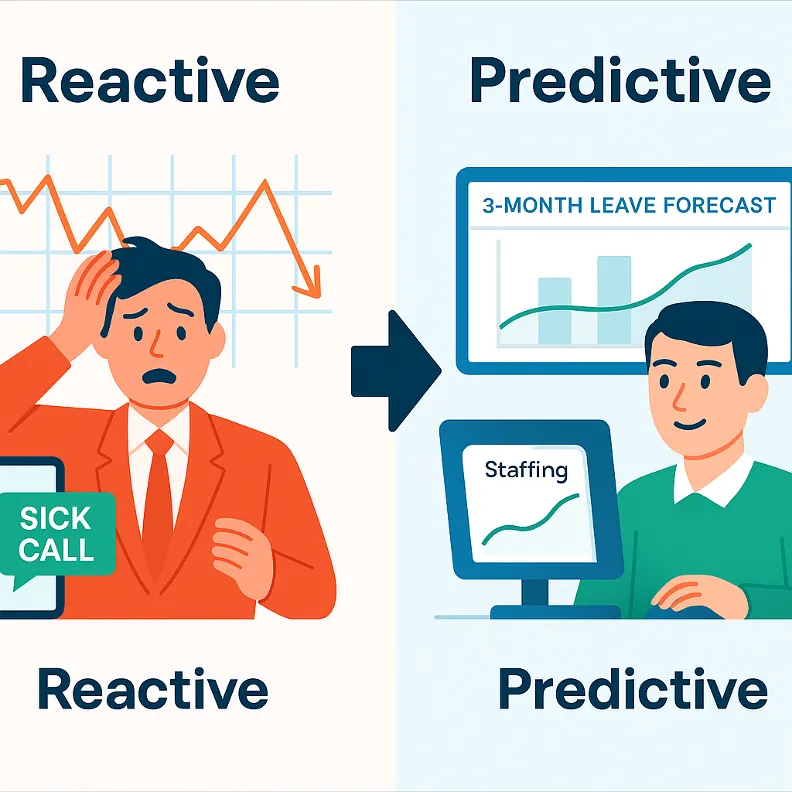
The goal was to move from reacting to absences to predicting and planning for capacity.
The 3-Month Forecasting Model: A formal process was instituted where all employees were required to submit planned leave requests for a rolling three-month period. This provided management with unprecedented visibility into future capacity constraints.
Leveraging Technology: Automated shift scheduling tools were implemented to manage rotations, ensure coverage for all time zones, and automatically flag potential shortfalls based on the forecast.
Building Redundancy: Cross-training programs were developed to create a bench of talent capable of covering critical roles, turning single points of failure into resilient teams.
4.2 Pillar 2: Process Standardization — The Architecture of Reliability
To eliminate variability, every critical process was documented, standardized, and equipped with quality checks.
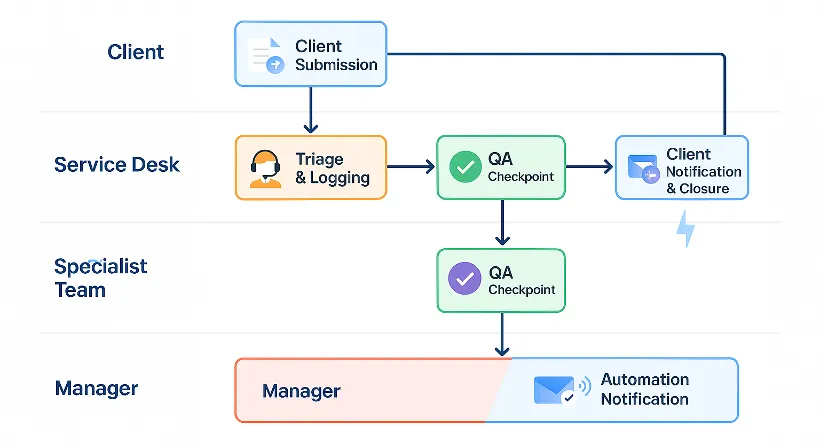
Documenting End-to-End Workflows: Key processes—from ticket intake and triage to execution, approval, and escalation—were mapped out in detail. These documents were stored in a central, accessible knowledge base.
Implementing Quality Assurance (QA) Checkpoints: Mandatory QA gates were established at critical junctures. For example, no ticket could be closed without a peer review if it involved a critical change. This embedded quality into the process itself.
4.3 Pillar 3: Proactive Client Governance — Building the "No-Surprise" Culture
Trust is built through transparency and predictability. The client communication model was overhauled from the ground up.
The Escalation Matrix: A clear, simple matrix was developed and shared with every client. It defined specific contacts for different issue types (technical, billing, strategic) and stipulated response time SLAs for each.
Structured Communication Protocols: Standard templates were created for:
- Issue Alerts: Notifying the client of a potential problem before it impacts them.
- Resolution Updates: Providing regular, scheduled updates until an issue is closed.
- Periodic Health Reports: Sharing performance data and insights proactively.
5. The Impact: Quantifying the Transformation
The implementation of the three-pillar framework delivered dramatic and measurable results.
6. Analysis: The Underlying Principles of Operational Excellence
This transformation succeeded because it was built on timeless principles:
- Proactivity over Reactivity: Anticipating issues (in staffing, processes, or client needs) is always cheaper and more effective than responding to them.
- Standardization over Heroics: Scalable and reliable operations are built on documented, repeatable processes, not on the heroic efforts of individuals.
- Transparency over Obscurity: Open, honest, and proactive communication builds trust with both clients and employees.
- Governance over Anarchy: Clear rules of engagement, accountability, and escalation are the hallmarks of a mature, high-performing organization.
7. Conclusion: The Journey from Cost Center to Value Engine
The journey from chaotic managed services to operational excellence is a transformative one. It moves the function from being perceived as a cost center—a necessary evil—to a true value engine and strategic partner. By implementing a framework of predictive planning, process standardization, and proactive governance, organizations can break the cycle of reactive firefighting. They can deliver on their promise of predictability, build unshakable client trust, and create an environment where employees are empowered to excel rather than just endure. This blueprint provides the roadmap to that destination.
8. Appendix: Starter Kit for Operational Excellence
- Workforce Planning Template: A simple spreadsheet for 3-month leave forecasting.
- Process Documentation Template: A standard template for documenting a workflow.
- Escalation Matrix Template: A sample client-facing escalation matrix.
- Communication Protocol Checklist: Guidelines for proactive client alerts and updates.
Case study: Global managed services provider · 80% fewer escalations, 30% SLA improvement DOWNLOAD PDF VERSION